Results for

Popular pages
Top Picks for International ![International]()


AUS
CA
EU
ID
IE
IT
JP
MY (EN)
MY
MX
MENA
NL
NZ
NG
NO
PE
PHL
PHL
RU
SG
ZA
KR
ES
ES
SE
TH
TR
UK
USA
VN
 ENG
ENG
Robin the Fair gives players the same problem seven times in a row: choose which of two face-down cards will be higher. Imagine Live released the game on February 19, 2024, using a custom set of 14 unique physical cards. The values run from 2 through Ace, with the Joker ranked above every standard card.
The format resembles top-card games such as Live Football Studio, but the resemblance ends after the card comparison. Football Studio asks for one pre-deal prediction. Robin the Fair turns the result into a climb, asks the player to choose again at every row, and introduces a cashout decision from row two.
A published operator rules page lists a 97% RTP, equal to a 3% house edge. Imagine Live’s public page does not display the RTP, so players should confirm the figure inside the rules panel of the table they open. The maximum payout is confirmed at 5,000x the original wager and depends on the randomly appearing Bonus Multiplier and progression through the card layout.
Players who enjoy the simplicity of Dragon Tiger but want more decisions may prefer this structure. The game requires little time to learn, yet its cashout system produces much higher volatility than a single-round top-card bet.
 Players from International accepted!
International
Rated :
4.2/5
| Game Specifications | |
|---|---|
| Game name | Robin the Fair |
| Game provider | Imagine Live |
| Game type | Game Shows |
| Streaming from | Armenia |
| RTP | 97% |
| Bet range | €€0.10 - €€3,000 |
| Max win | 5000x |
| Side bets | N/A |
| Supported platforms |


|
| Supported OS |
|
| Languages |
 English
|
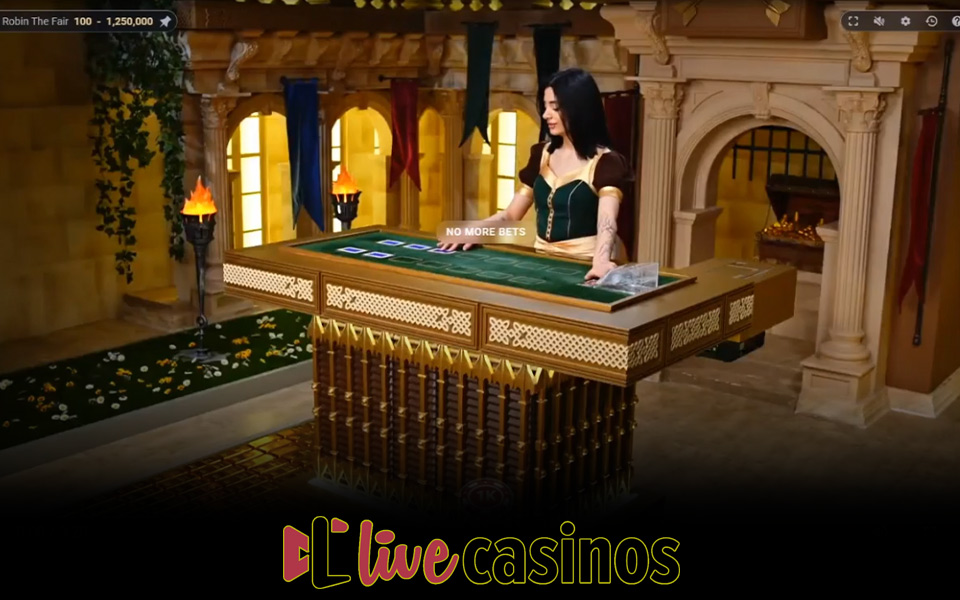
Each run begins with one wager. The presenter places 14 physical cards face down on a green table in seven rows of two. The wide camera angle shows the complete layout during the deal before the interface moves closer for the first decision.
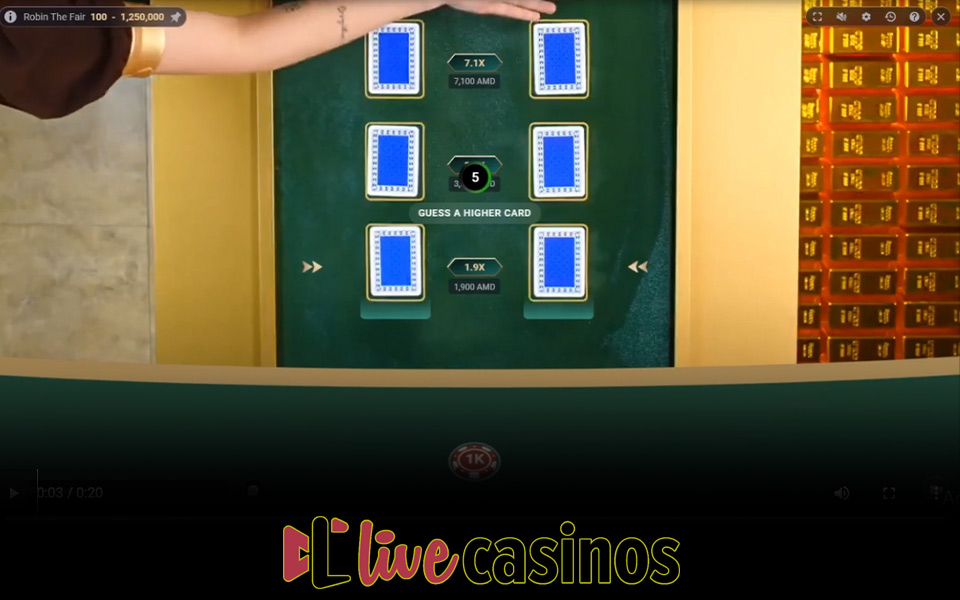
The active pair appears at the bottom of the screen. A countdown gives the player several seconds to select the left or right card, while potential multipliers and their cash equivalents are shown between the rows. In the screenshots reviewed, a 1,000 AMD bet produced displayed values of 1.9x/1,900 AMD, 3.6x/3,600 AMD, and 7.1x/7,100 AMD. These are examples from one run rather than fixed row payouts.
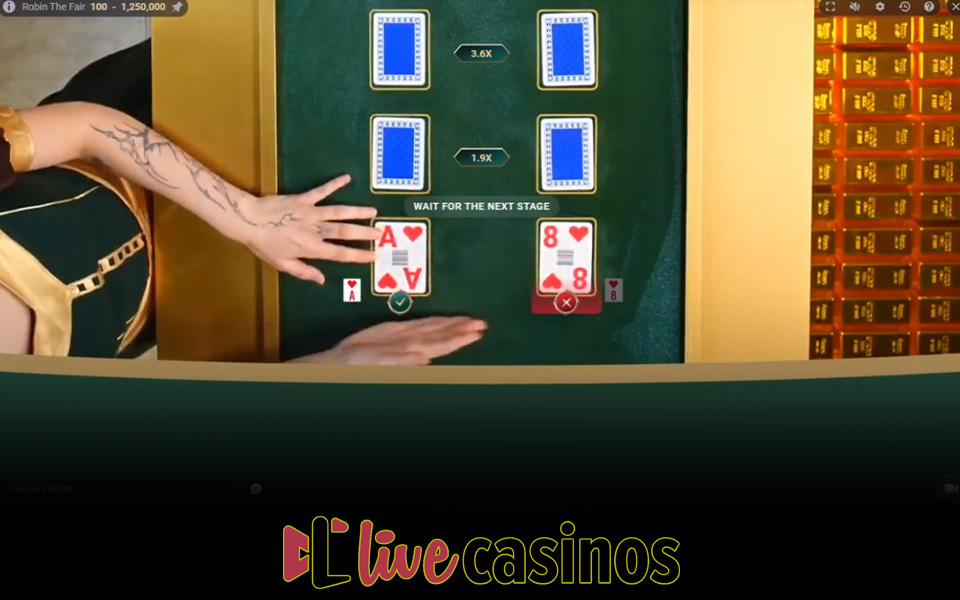
After the player chooses, the interface places a target icon on that card. The presenter turns over both cards, and the higher card is identified by the values shown beside the result. A correct choice advances the run. An incorrect choice ends it. Because the custom set contains one card of each rank from 2 through Ace plus one Joker, every pair contains two different values.
Once the game reaches row two, cashout becomes available. The player can take the displayed value or leave the original stake and accumulated return exposed while choosing again. A randomly generated Bonus Multiplier can appear at any row and can raise the total payout as high as 5,000x.
Imagine Live also includes Multiview and Rejoin. Multiview lets players switch between camera perspectives, while Rejoin allows a player who leaves mid-session to return to the same game state. The provider says desktop shows the wider progression and betting history, while mobile keeps the current row and multiplier at the center of the screen.

Robin the Fair uses 14 physical cards with unique values from 2 through Ace, plus a Joker that ranks above every standard card. The presenter arranges the cards face down in seven rows, with two cards in each row. Your task is to select the higher card from the active pair and continue climbing through the layout.
A correct selection moves the game to the next row and increases the available payout. After reaching the second row, you can collect the displayed amount or risk it on another choice. Random Bonus Multipliers can increase the value of individual stages and take the maximum payout up to 5,000x the original bet.
The cards are face down when you make your choice, so neither position gives you a mathematical advantage. For a closer look at a similar higher-card format, read our Dragon Tiger guide.
Step 1: Betting Phase:
Choose your chip value and place one wager before the betting countdown ends. Table limits may differ between casinos, currencies, and regional versions.
Step 2: Card Layout:
The presenter places 14 physical cards face down across seven rows. Each rank from 2 through Ace appears once, together with one Joker, so the two cards in a pair cannot have the same value.
Step 3: Card Selection:
Choose the left or right card from the active pair before the decision timer expires. Both cards remain hidden during the selection, and a target symbol appears over your chosen card.
Step 4: Card Reveal:
The presenter turns over both cards. Standard cards follow their usual ranking from 2 to Ace, while the Joker beats every other card. Selecting the higher card moves you to the next row. Selecting the lower card ends the run and returns 0x.
Step 5: Multiplier Progression:
After a correct choice, the interface displays the multiplier available at the next stage and its cash value based on your opening stake. Random Bonus Multipliers may appear during the climb and increase the potential return.
Step 6: Cashout Decision:
Cashout becomes available from the second row. You can collect the amount displayed on screen or continue to the next pair. Continuing places the full accumulated return at risk on another face-down card selection.
Step 7: End of the Run:
The run finishes when you cash out, select the lower card, or complete the final row. Confirmed winnings are credited automatically before the game opens a new betting phase. The highest possible payout is 5,000x the original stake.
The cards are face down and their position does not reveal their rank. Selecting left because it lost previously, following the presenter’s hand, or alternating sides cannot improve the next choice. Each decision should be treated as a fresh unknown.
Decide whether you plan to leave at a particular row, multiplier, or cash amount. Making that decision before the value starts rising reduces the temptation to keep extending a successful run without a limit.
The interface shows both figures. A 7.1x return may look smaller than the 5,000x maximum, but it already exposes the entire accumulated value to one more face-down choice. Use the amount you would actually receive to decide whether the next stage is worth the risk.
A failed run does not make the next one more likely to succeed. Raising the next wager after a loss can make a short sequence of incorrect choices much more expensive.
Choosing an Ace that loses to the Joker or selecting a card only one rank below the winner does not affect the next layout. The cards are either higher or lower for settlement purposes, and a narrow loss gives no useful signal.
| Pros | Cons |
|---|---|
| Physical cards determine every result | One wrong choice ends the entire run |
| Players make a card choice at every row | The decision timer leaves little time to reconsider |
| Cashout becomes available from the second row | Choosing the left or right card provides no strategic advantage |
| Multipliers and their corresponding cash values remain visible | Continuing through later rows exposes the accumulated return to another card choice |
| Random Bonus Multipliers can increase payouts up to 5,000x | The repeated higher-card decisions may become predictable during longer sessions |
| Multiview and Rejoin functions improve the live-game experience | There is no major excitement after initial discovery of the game |
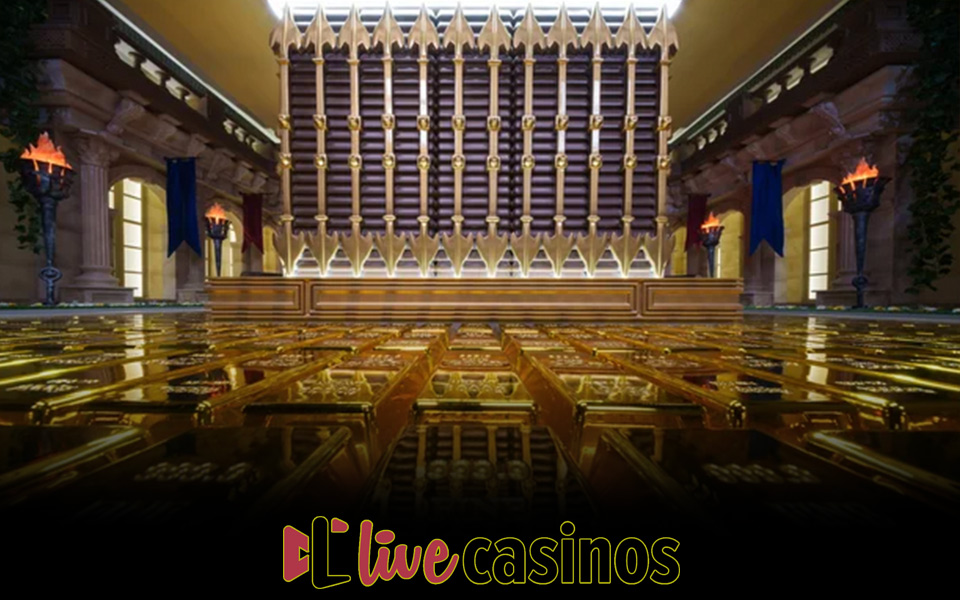
Robin the Fair works because it gives a familiar higher-card idea a stronger decision loop. The physical cards, repeated selections, and visible cashout values make each stage easy to understand. The presenter and themed studio support the game without pulling attention away from the active pair.
The main weakness is the same feature that creates the tension. Players are repeatedly invited to risk a displayed return for the next multiplier, and the 5,000x ceiling makes the later rows look more tempting than their volatility warrants. The provider’s public material also needs a complete row-by-row payout explanation and clearer RTP disclosure.
This is a good fit for players who find standard top-card games too brief and wheel game shows too crowded. Anyone who prefers one wager followed by one result may find the seven-row climb slower and more repetitive than Evolution War Live. With a cashout plan and controlled stakes, Robin the Fair is one of Imagine Live’s more distinctive game-show ideas.
Excellent
Our live casino game reviews follow a structured process. You can read the complete live casino game review methodology, while the Robin the Fair assessment covers the following areas:
Ratings are based on rules, observed player-facing evidence, and practical value. Provider marketing claims do not decide the score.
Robin the Fair should be treated as a chance-based live casino game. Choosing a card creates a sense of control, but both options remain face down and the player has no information that can identify the higher one in advance.
Set a budget before starting and decide how you will handle cashout decisions. A growing multiplier can make another choice feel justified, even though one wrong selection removes the value accumulated during that run. Avoid increasing the next stake to recover a failed climb or chasing the 5,000x maximum after reaching a lower multiplier.
The rounds require repeated decisions and can hold attention for longer than a one-result card game. Set a session limit, take regular breaks, and use the casino’s deposit, loss, time, and self-exclusion controls when needed. Our responsible gambling guide covers these tools in more detail.
If gambling stops being enjoyable or begins to feel stressful, support is available through:
Gambling should never be used to solve financial problems or manage emotional stress.

Last Update: August 7, 2026
Let me know






















 Roulette
 Blackjack
 Baccarat
 Poker
Poker
 Sic Bo
 Dragon Tiger
 Game Shows
  Top 5 Games
  See more
  Roulette Casinos
  Low Limit
  High Limit / VIP
  Exclusive
  How to Play
  Basic Strategy
  Top Tips
  FAQ
FAQ  Blackjack Casinos
  Baccarat Casinos
  Bonuses
  Poker Casinos
  Game Providers
  Sic Bo Casinos
  Dragon Tiger Casinos
  Credit and Debit Card
  e-Wallet
  Cryptocurrency
  Bank and Checks
  Pay by Phone and SMS
  See more
  How-To Guides
  Top Lists
  In-Depth
  Strategy
  Casino & Games
  Insight
  News
News  Promotions
  Guide to Live Casinos
  Top 10 Live Casino Tips
  Studio Locations
  FAQ & Help
  Meet The Dealers
  Our Awards
  How We Rate
  Responsible Gambling