Results for

Popular pages
Top Picks for United States ![United States]()


AUS
CA
EU
ID
IE
IT
JP
MY (EN)
MY
MX
MENA
NL
NZ
NG
NO
PE
PHL
PHL
RU
SG
ZA
KR
ES
ES
SE
TH
TR
UK
USA
VN
 ENG
ENG
Crypt of Giza is a pachinko-based live casino game show made and released by Betgames in 2025. As the world’s first dedicated live pachinko experience, this innovative title combines physical pachinko mechanics with three immersive bonus rounds, offering multipliers up to 10,000x your stake. The game is purely based on luck and quite volatile, but it also suffers from a relatively high house edge with 95.08% RTP. However, it’s also one of Betgame’s most advanced and visually stunning releases, rivalling the best in the business in terms of production value.
In this Crypt of Giza review, we’ll take a close look at the game, how it works, and what it has to offer. We’ll cover its maths, pros, cons, and potential strategies you can use while playing. We’ll also compare it to similar releases from software providers, giving you a complete picture of whether Crypt of Giza is worth playing.
 Players from United States accepted!
United States
Rated :
4.3/5
| Game Specifications | |
|---|---|
| Game name | Crypt of Giza |
| Game provider | Betgames |
| Game type | Game Shows |
| Streaming from | |
| RTP | 95.08% |
| Bet range | €0.10 - €500 |
| Max win | 10,000x |
| Side bets | No |
| Supported platforms | |
| Supported OS |


|
| Languages |
 English
|
Crypt of Giza represents BetGames‘ most ambitious project to date, combining the physics-based excitement of pachinko with the production values of premium casino game shows.
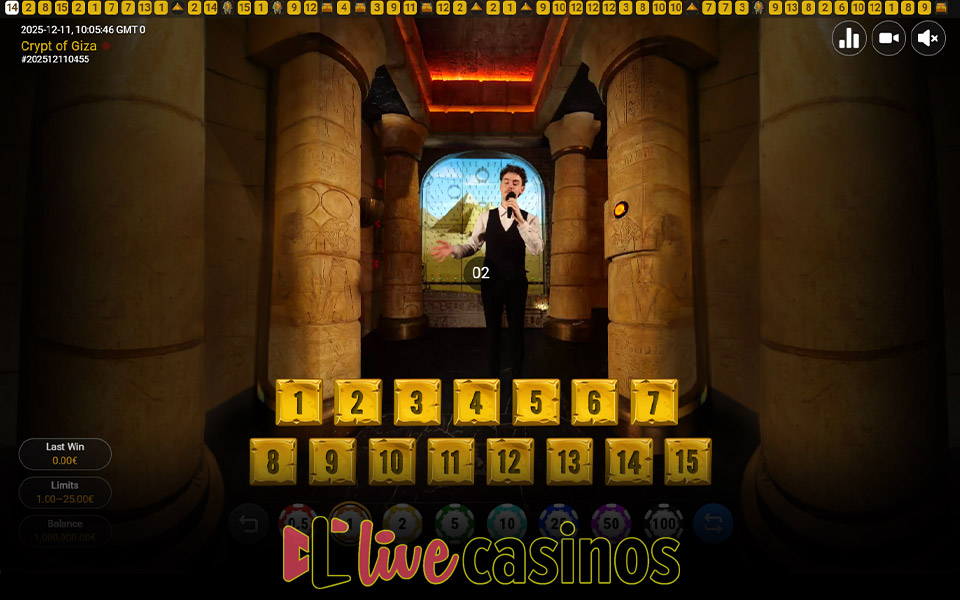
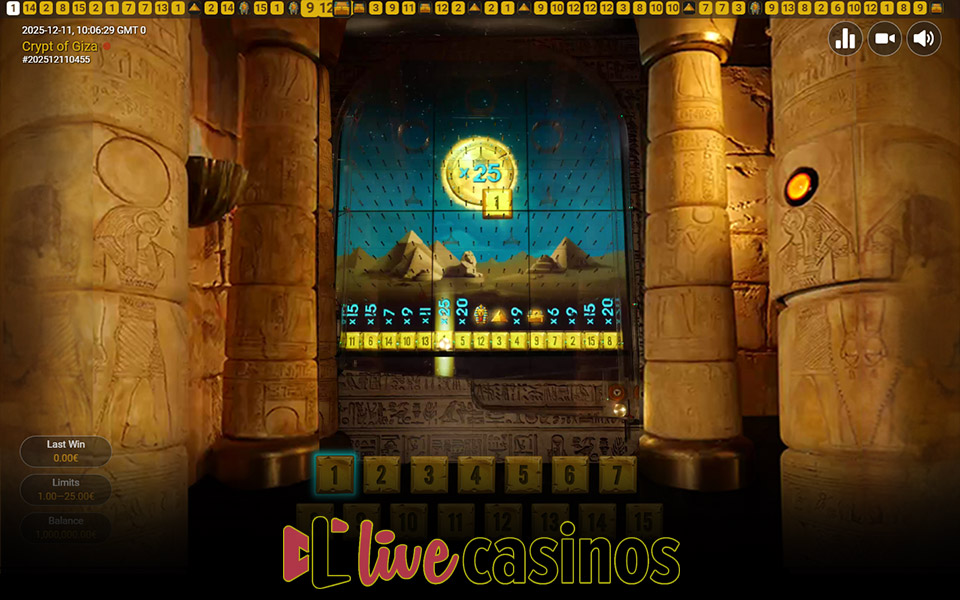
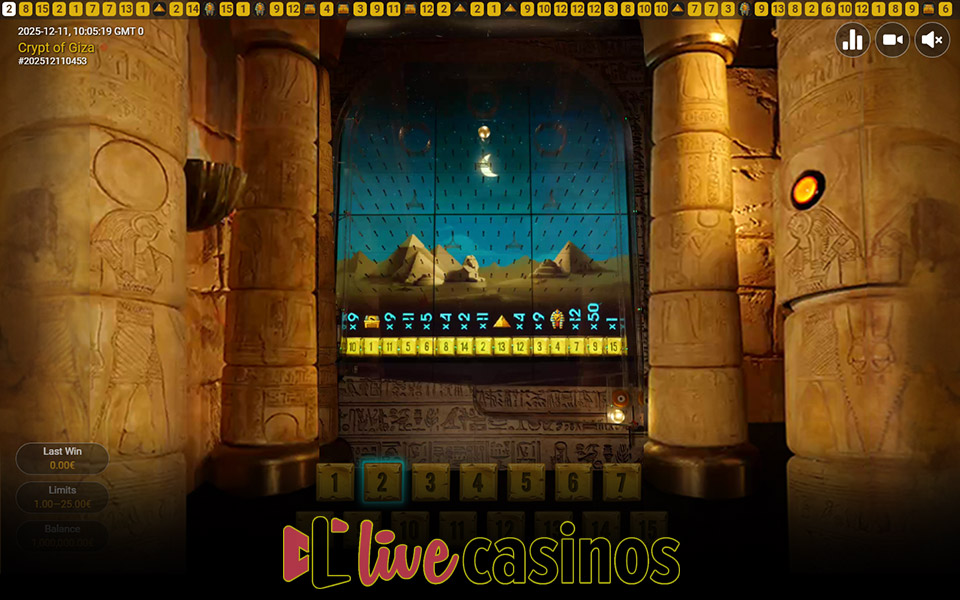
The game centers around a massive physical pachinko board where a ball drops through a field of pegs, ultimately landing in one of 15 numbered pockets at the bottom. Each pocket is assigned a multiplier, and players bet on which pocket they believe the ball will land in.
What elevates Crypt of Giza beyond simple pachinko mechanics is its ancient Egyptian theming and three elaborate bonus rounds. The studio is designed to evoke mysterious pharaoh tombs, complete with hieroglyphics, golden artefacts, and dramatic lighting.
Professional presenters dressed as archaeologists guide players through each round, adding commentary and building anticipation as the ball makes its unpredictable journey down the board. From a gameplay perspective, though, this combination of features sometimes makes Crypt of Giza feel like a live slot machine.
However, it’s also the world’s first true live pachinko machine. Evolution’s Crazy Pachinko technically featured similar mechanics, which were themselves borrowed from the famed Crazy Time game show. However, Evo’s Pachinko machines were largely constrained to bonus rounds and similar features. In the Crypt of Giza, the pachinko board is the centerpiece.
The game was born from nearly 18 months of creative development, and BetGames proudly touts it as “the world’s first physical pachinko live game show studio – a true engineering masterpiece.”
Unlike simulated versions, Crypt of Giza uses actual physical components, meaning every ball drop is governed by real-world physics rather than RNG algorithms. This authenticity creates genuine suspense, and it makes the whole thing feel more ‘real’. On a personal note, we here at LiveCasinos vastly prefer real props over RNG simulations, so kudos to Betgames.
As a fully unique product, Crypt of Giza does not have a direct comparison in the current live casino industry. However, Evolution’s Crazy Pachinko is a solid reference point thanks to its popularity.
| Feature | Crypt of Giza (BetGames) | Crazy Pachinko (Evolution) |
| Game Type | Physical Pachinko | Bonus Round Only |
| RTP | 95.08% | ~96% (varies) |
| Max Multiplier | 10,000x | 10,000x |
| Bonus Rounds | 3 dedicated types | Part of a larger game |
| Physical Components | Yes (real pachinko) | Yes (real pachinko) |
| Theme | Ancient Egypt | Carnival/Crazy |
| Betting Options | 15 pockets | 16 pockets (in bonus) |
| Volatility | High | Very High |
| Round Duration | 30-60 seconds | Varies |
| Launch Year | 2023 | 2020 |

Crypt of Giza is a straightforward and beginner-friendly game: you simply make a bet and hope for the best. Here’s how it works.
Crypt of Giza’s three bonus rounds are where the game truly shines, offering interactive elements and the potential for massive multipliers. Each bonus round is triggered by the ball landing on its corresponding pocket. All players with an active bet on that pocket participate in the round.
Triggered by landing on a pocket with a pyramid symbol, Gift from the Gods presents players with three Egyptian gods arranged before them.
You select one urn to reveal a hidden multiplier, which is then applied to your bet. The goal is simply to blindly pick the highest multiplier possible. If you don’t make a selection before time runs out, a god will be chosen randomly
This is the most straightforward of the three bonuses – a simple “pick and win” format. However, the drama comes from the reveal, as multipliers can range from modest (10x-25x) to substantial (up to 500x).
The Valley of the Cobra bonus round is triggered by the treasure chest symbol. It’s somewhat more complex than the other ones.
The round uses the same pachinko board from the same round. However, the pockets at the bottom are replaced by blue coins, red coins, and a cobra symbol. The coins are all assigned multipliers, much like in the base game.
Your job is to pick a color before each drop – red or blue. If the ball lands on the correct color, you collect the multiplier assigned to the winning coin. If it lands on the other color than the one you predicted, you continue the round but don’t increase your winnings. If it lands on the Cobra symbol, the round ends immediately, and your prize for the round is zero.
This bonus features multiple ball drops – typically up to six rounds. Before each drop, you get to decide whether you want to pick a color or cash out. If you decide to play, any multipliers you collect are added together and accumulated as a big payout. If you cash out, you simply collect any winnings accumulated up to that point and take them as your prize for the round.
The multipliers typically grow with each successive round, rewarding brave players. However, the number of Cobras on the board also increases, growing from 1 to 3, then 5, 7, 9, and 14. This means that later drops are increasingly hard to survive, but offer better rewards.
On a side note, if the ball lands on the Cobra in the first round, the game ends, but all bets are awarded a single multiplier as a consolation prize.
The Wall of Mystery bonus, activated by pharaoh symbols, is another simple bonus game that consists of blindly picking a hidden prize.
It presents players with 18 hieroglyphic symbols arranged in a grid on the ancient tomb wall. Your task is simple: select one hieroglyphic to reveal the multiplier hidden behind it. This bonus offers the highest multiplier potential in the game, with some hidden values reaching up to 10,000x your stake.
What makes this bonus particularly exciting is the wide range of possible outcomes. Unlike Gift from the Gods, which tends toward mid-range multipliers, Wall of Mystery is genuinely high-volatility.
Ultimately, Crypt of Giza is fully a game of chance. You have no way of directly impacting the outcome, which means you can’t increase your chances of winning using strategy.
Additionally, the game “shuffles” the locations of pockets in every round, as well as their payouts. This is important becuase, in stark contrast to classic pachinko mechanics, you can’t control the riskiness of your bets.
Traditionally, pockets near the center of the board tend to win more often because of the physics of how the ball rolls down the pegs. While this is still true in Crypt of Giza, you can’t really know which pockets will end up in the center and which ones will be off to the sides. Similarly, the payouts are fully randomized – big multipliers can end up at the center, and small multipliers can still be at the edges. This means that there is no real element of balancing risk and reward – you just pick numbers at random and hope for the best.
Each pocket has a 1-in-15 chance to win, which is approximately 6.67%. Since you don’t know where the pocket number will end up, there’s no point in trying to guess which will be more likely to win. Each pocket also has the same payout range.
This means that the only real decision in Crypt of Giza is: how many bets should you make?
Mathematically, there is no correct answer. The RTP remains the same no matter how many picks you make. However, we should consider some points:
The Valley of the Cobra bonus requires active decision-making that can significantly impact your final payout.
A recommended approach is the “two-and-out” strategy: take two successful drops, then cash out regardless of the temptation to continue. Statistical analysis suggests that most players who push beyond three drops end up hitting a cobra and losing everything.
| Pros | Cons |
|
✅ Solid 97.30% RTP matching standard European roulette ✅ Genuine physical pachinko mechanics (not RNG simulation) ✅ Three distinct bonus rounds with varying mechanics ✅ Massive 10,000x maximum multiplier potential ✅ Racetrack betting area and several QoL UI features ✅ Impressive ancient Egyptian studio design and atmosphere |
❌ Low RTP – 95.08% ❌ High volatility can quickly drain your bankroll ❌ Two bonus rounds are fundamentally just a blind picking game
|
Understanding Crypt of Giza’s payout structure is essential for setting appropriate expectations and making informed betting decisions. The game uses a straightforward multiplier-based system, but the wide range of potential outcomes means results can vary dramatically.
The payout calculation in Crypt of Giza is simple. Your total payout equals your bet amount multiplied by the multiplier value you land on. For example:
Example 1 (Base Game): You bet $20 on pocket 9. The ball lands in pocket 9 with a 45x multiplier displayed. Your payout is $20 × 45 = $900.
Example 2 (Bonus Round): You bet $10 on pocket 5. The ball lands in pocket 5, which displays a Valley of the Cobra bonus icon. You successfully navigate three drops in the bonus and cash out with an accumulated 380x multiplier. Your payout is $10 × 380 = $3,800.
Crypt of Giza is fundamentally a game of chance with a 95.08% RTP for base game bets. This means that over thousands of rounds, the game will return approximately $95.08 for every $100 wagered.
However, the high volatility nature of the game means individual sessions can vary wildly from this average. You might experience long losing streaks or sudden massive wins.
Broadly speaking, this is a fairly poor RTP rate by any standard. It’s substantially lower than most live dealer casino games, and it’s fairly low even when compared to many slot machines. Although the RTP is not low enough to be an automatic deal-breaker, it’s still something you should consider before playing.

Make sure to choose the game that suits your taste and budget. For more extensive guides on live casino games, check out this page.
The straightforward gameplay requires only a simple UI. That said, Crypt of Giza does not rely on Betgames’ patented betting system. Instead, it’s a classic live casino layout with betting positions and a few options menus.
The user interface is clean and Egyptian-themed, with golden accents and hieroglyphic decorative elements that never interfere with functionality. All 15 pockets are clearly labelled with their current multipliers in large, readable numbers. Bonus icons are distinctive and easy to identify at a glance. The betting interface is intuitive, with clear confirmation of your selected pockets and total stake.
BetGames invested heavily in Crypt of Giza’s production values, and it shows in every frame. The studio is designed to evoke ancient Egypt. Golden sphinxes flank the massive pachinko board, complete with hieroglyphic-covered walls and dramatic shadows.
The pachinko board itself is likely the most impressive bit, though, combining a physical board with CGI special effects. The ball is specifically designed to be highly visible against the board’s background. However, it’s worth noting that the board is far behind the presenter during the betting period.
Beyond that, the game demonstrates BetGames’ technical expertise. It looks good, runs well, and remains stable and lag-free regardless of your connection speed or hardware.
Crypt of Giza translates exceptionally well to mobile devices, which is crucial given the increasing prevalence of smartphone gaming. BetGames optimized the game specifically for smaller screens, and it shows in thoughtful design choices throughout.
The game is largely presented as a typical live dealer casino game show. In other words, it’s full of spectacle and focuses on entertainment instead of simple callouts and announcements.
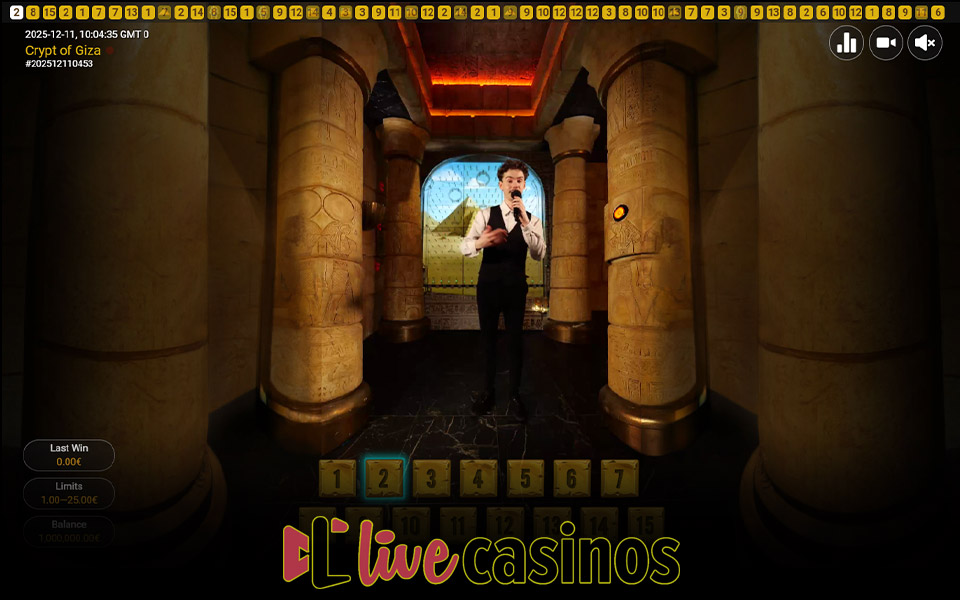
The presenters deserve special mention. Dressed in adventure-archaeology attire (think Indiana Jones meets ancient Egypt), they deliver energetic, enthusiastic commentary that keeps players engaged and immersed. Their presence strikes the right balance between professional and personable.
The presenters deserve special mention. Dressed in adventure-archaeology attire (think Indiana Jones meets ancient Egypt), they deliver energetic, enthusiastic commentary
Overall, our impressions of Crypt of Giza are positive, but the game is not without its downsides.
For starters, let’s note that BetGames successfully created the first dedicated live pachinko studio experience, and the 18-month development period shows in the meticulous attention to detail. The physical pachinko mechanics deliver authentic, unpredictable results that create genuine suspense with every ball drop. The theme is pulled off beautifully, and the mechanics themselves are fun enough.
However, some players may be annoyed at the way the pockets and payouts are shuffled in every round. This means that all main bets are essentially the same, which can cause things to be a bit repetative after a while.
However, the game’s biggest pitfall is the house edge. No matter how you look at it, 95.08% is pretty bad, and might deter a lot of potential customers. Pushing it up to, say, a solid 97% could turn this game into a real achievement.
Speaking of the payouts, they’re quite volatile, which is to be expected from a game show. High-volatility players will love this game, while those preferring frequent small wins should look elsewhere.
Crypt of Giza succeeds in its core mission: delivering thrilling pachinko-based entertainment with outstanding production values. The physical mechanics create authentic suspense, the bonus rounds provide variety and big-win potential, and the Egyptian atmosphere makes every session feel like an adventure. We would have no issue recommending this title to anyone were it not for the low RTP. As it stands, it’s a fun and creative game, but the math model is a noticeable issue.
Excellent
Here at Livecasinos.com, how we rate casino games is based on a strict set of standards that were developed over many years of playing and analyzing live dealer games of all sorts. Here are some of the key factors we consider before giving our recommendation:
As colorful and fresh as it is, Crypt of Giza is a real-money gambling game. Make sure to keep the dangers of gambling in mind while playing.
Remember that Crypt of Giza is entertainment, not a way to make money. The high volatility means you should only play with money you can genuinely afford to lose. Set strict budgets before playing, never chase losses, and take regular breaks. The 10,000x wins are possible but rare – most sessions will not produce massive wins. If gambling stops being fun and starts feeling stressful, take a break or seek help from problem gambling support organizations:

Last Update: December 23, 2025
Let me know






















 Roulette
 Blackjack
 Baccarat
 Poker
Poker
 Sic Bo
 Dragon Tiger
 Game Shows
  Top 5 Games
  See more
  Roulette Casinos
  Low Limit
  High Limit / VIP
  Exclusive
  How to Play
  Basic Strategy
  Top Tips
  FAQ
FAQ  Blackjack Casinos
  Baccarat Casinos
  Bonuses
  Poker Casinos
  Game Providers
  Sic Bo Casinos
  Dragon Tiger Casinos
  Credit and Debit Card
  e-Wallet
  Cryptocurrency
  Bank and Checks
  Pay by Phone and SMS
  See more
  How-To Guides
  Top Lists
  In-Depth
  Strategy
  Casino & Games
  Insight
  News
News  Promotions
  Guide to Live Casinos
  Top 10 Live Casino Tips
  Studio Locations
  FAQ & Help
  Meet The Dealers
  Our Awards
  How We Rate
  Responsible Gambling