Results for

Popular pages
Top Picks for United States ![United States]()


AUS
CA
EU
ID
IE
IT
JP
MY (EN)
MY
MX
MENA
NL
NZ
NG
NO
PE
PHL
PHL
RU
SG
ZA
KR
ES
ES
SE
TH
TR
UK
USA
VN
 ENG
ENG
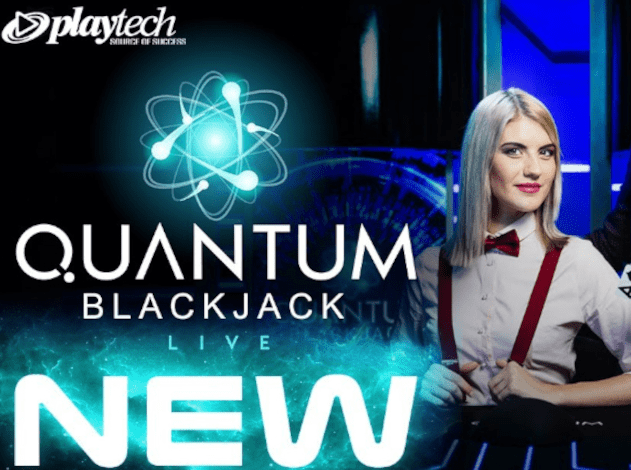
Live Quantum Blackjack by Playtech is a live dealer blackjack game released in 2020. It features an RTP of 99.47%, with a minimum bet of $5 and a maximum wager of $2,000. The game is available on both desktop and mobile devices and introduces random win multipliers to enhance the traditional blackjack experience.
Entertainment-focused live table games have been a growing trend in the industry, and Playtech’s Quantum series is a notable example. Quantum Blackjack represents one of the company’s most ambitious live dealer projects, combining classic blackjack rules with visually striking multipliers and game-show elements. Below, we take a closer look at how it works and what sets it apart.
 Players from United States accepted!
United States
Rated :
4.5/5
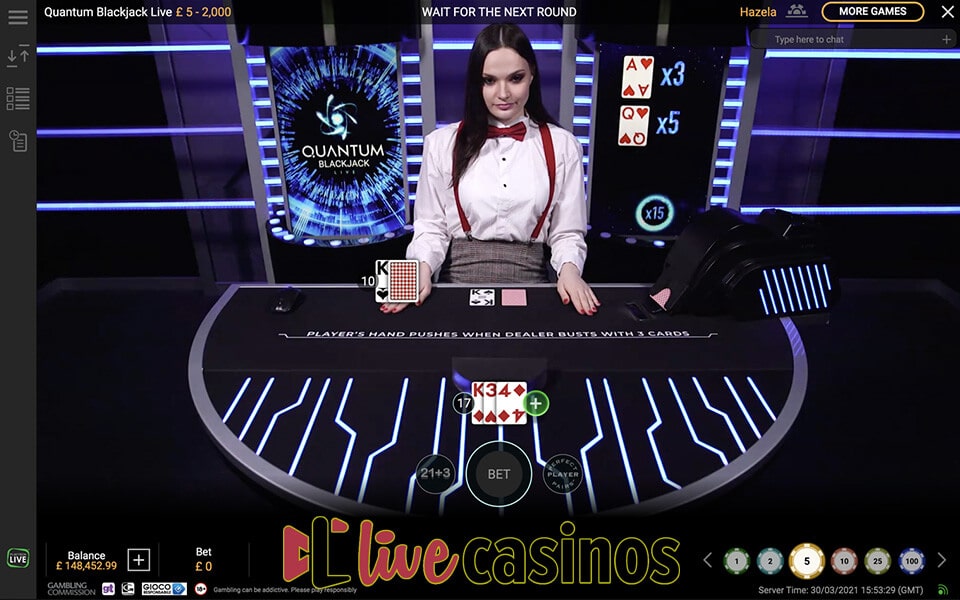
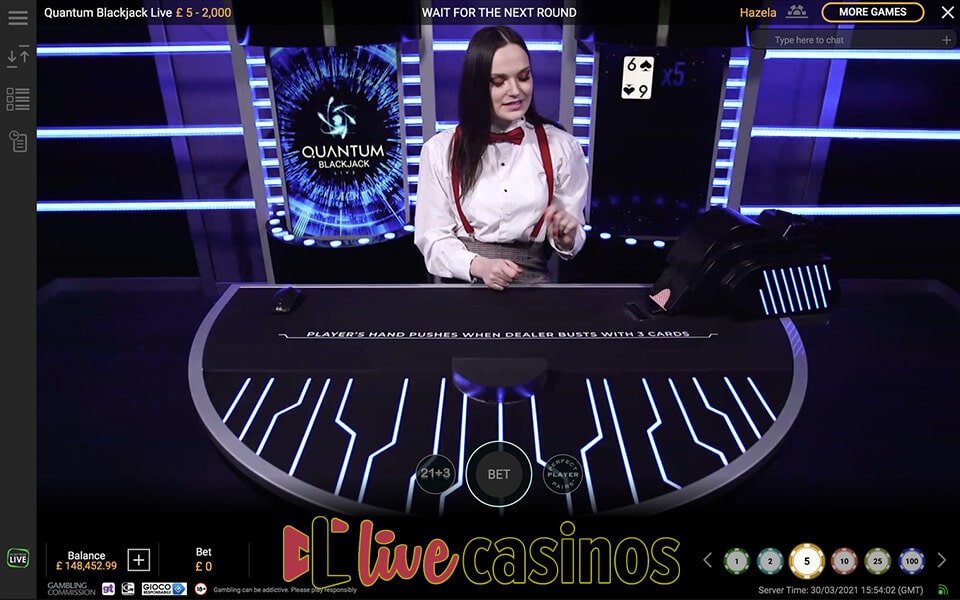
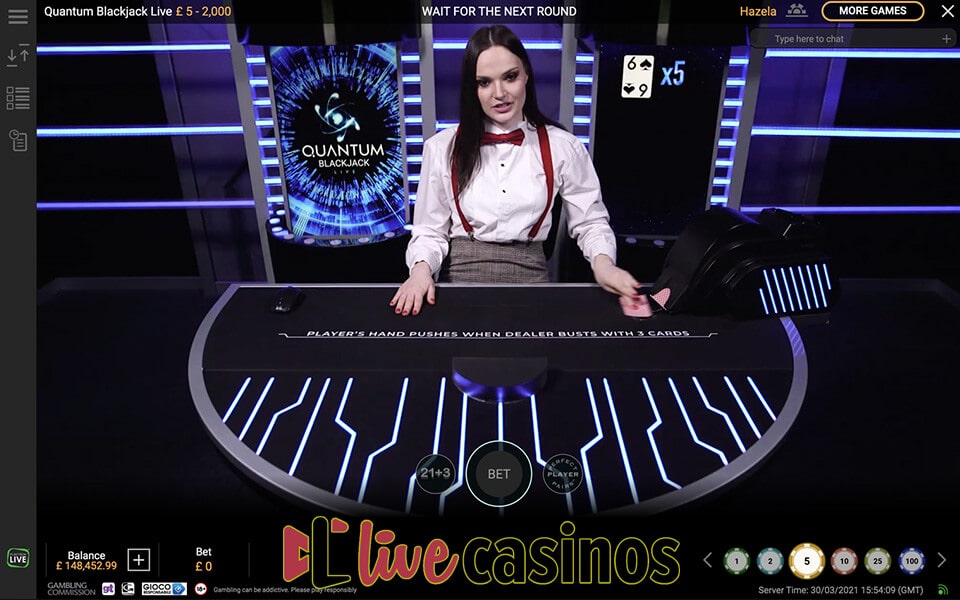
| Game Specifications | |
|---|---|
| Game name | Live Quantum Blackjack |
| Game provider | Playtech |
| Game type | Blackjack |
| Streaming from | Latvia |
| RTP | 99.47% |
| Bet range | €5 - €2000 |
| Max win | 999:1 |
| Side bets | Yes |
| Supported platforms |


|
| Supported OS |
|
| Languages |
 Czech
Czech
 Dutch
Dutch
 English
 French
 German
 Greek
+9
Greek
+9
All supported languages
|
Live Quantum Blackjack was released alongside Buffalo Blitz Live Slots, marking an expansion of Playtech’s live portfolio in early 2020. Just like Quantum Roulette, Quantum Blackjack aims to introduce a new twist to traditional gameplay. It retains the familiar mechanics of standard blackjack, so players who know the basic rules of 21 can transition easily. The key difference lies in the addition of RNG-generated multipliers, which can enhance winning outcomes during play.
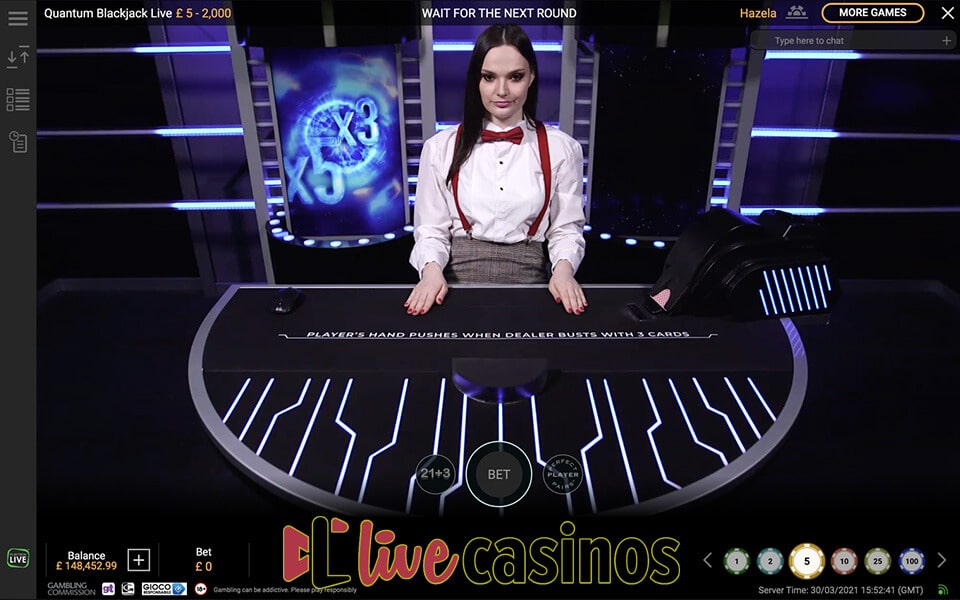
Playtech has also focused heavily on presentation with the Quantum series. The studio features a dark, high-contrast environment illuminated by neon blue accents, creating a modern, futuristic aesthetic. While Evolution Gaming is often recognised for visually striking studios, Playtech’s Quantum design direction demonstrates a strong commitment to competing at the same level.
The dealers maintain a professional and polished appearance, typically dressed in bowties and formal shirts, helping reinforce the game-show style atmosphere of the Quantum series.

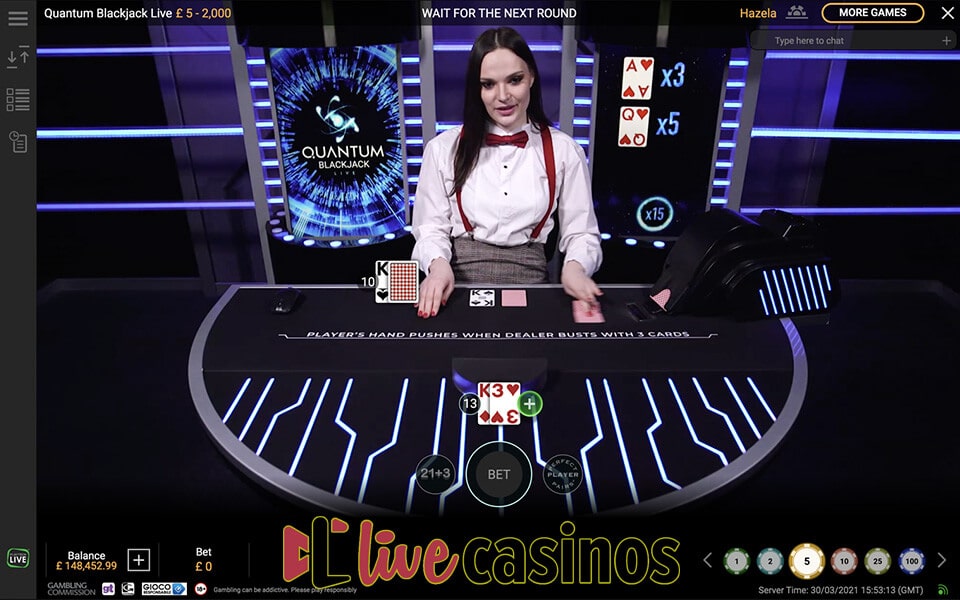
The game uses eight standard 52-card decks, which are shuffled after each round. Instead of a traditional 7-seat table, Quantum Blackjack follows a single-hand format in which the dealer deals one hand shared by an unlimited number of players. Each participant then makes independent decisions (hit, stand, double, etc.), allowing individual outcomes despite playing from the same initial cards.
At the start of each round, an RNG engine displayed in the upper-right corner selects three random cards and assigns them multiplier values. These Quantum Multipliers can reach up to 10× per card. If a player is dealt one or more of the selected multiplier cards, any potential win for that hand is multiplied accordingly. When multiple multiplier cards appear in the same winning hand, their values are multiplied together to form a combined Quantum Multiplier. For example, three 10× cards would produce a 1,000× combined multiplier.
Multipliers apply only if the player’s final hand beats the dealer. If the player busts on a three-card hand, the round results in a push and the stake is returned. In this situation, any multiplier-related winnings associated with the three cards are still paid. Players also have access to two optional side bets: Perfect Pairs and 21+3.
Understanding how Quantum Multipliers work is essential to appreciating what sets Playtech Quantum Blackjack apart. While the core gameplay remains similar to standard blackjack, the multiplier mechanic introduces additional volatility and distinguishes this title from traditional live dealer formats.
According to Playtech, the main game in Quantum Blackjack has an RTP of 99.47%, which corresponds to a house edge of 0.53% when using optimal strategy. As with all blackjack variants, this theoretical return assumes consistent use of mathematically optimal decisions. However, the presence of RNG multipliers can influence how players perceive certain choices, and adhering strictly to optimal strategy may feel counterintuitive when enhanced multipliers appear on specific cards.
It is important to note that multipliers are assigned randomly and do not alter the underlying probabilities of completing a hand. Decisions such as hitting, standing, splitting, or doubling still follow the same statistical foundations as standard blackjack. The multiplier system affects payouts, not the likelihood of a particular outcome.
Players should keep in mind that deviations from optimal strategy will generally lead to a lower effective RTP. Side bets such as Perfect Pairs and 21+3—as in other blackjack variants—have lower RTP values and are designed as optional additions rather than core strategic components.
The game’s presentation carries a noticeable sci-fi aesthetic, with a dark studio setting accented by bright neon lighting. This gives Quantum Blackjack a visually distinctive look compared to standard live blackjack tables. The gameplay also differs in meaningful ways due to the addition of multiplier mechanics, which are not commonly found in traditional blackjack variants and contribute to the game’s unique style within the live casino category.
Below, you’ll find the Quantum Blackjack paytable. It is largely the same as in other Playtech blackjack games, including the two optional side bets. However, the paytable does not reflect the game’s signature mechanics. Quantum Multipliers can be applied to a variety of card values and can combine in multiple ways, which significantly affects potential payouts.
Likewise, the paytable does not show the rule that a three-card bust results in a push. In these cases, the player’s stake is returned, and any multiplier-related winnings tied to the three cards are still paid where applicable. This rule, along with the multiplier system, introduces gameplay differences that are not visible on the standard paytable.
| Bet | Payout | ||
|---|---|---|---|
| Quantum Blackjack Payouts | |||
| Regular | 1:1 | ||
| Blackjack | 3:2 | ||
| Blackjack Insurance | 2:1 | ||
| Perfect Pairs Side Bet | |||
| Mixed Pair | 6:1 | ||
| Colored Pair | 12:1 | ||
| Suited Pair | 25:1 | ||
| 21+3 Side Bet | |||
| Suited Trips | 100:1 | ||
| Straight Flush | 40:1 | ||
| Three of a Kind | 30:1 | ||
| Straight | 10:1 | ||
| Flush | 5:1 | ||
All of this results in an RTP of 99.47%, which places Quantum Blackjack in line with the RTP values found in many standard live blackjack games. The combination of multipliers and the additional push rule appears to be balanced in a way that maintains a familiar overall return profile for the main bet.
As with most blackjack variants, the side bets have lower RTP values compared to the main wager. In Quantum Blackjack, Perfect Pairs has an RTP of 95.90%, while 21+3 offers an RTP of 96.30%. These values are typical for blackjack side bets and reflect their higher-volatility, optional nature.

Make sure to choose the game that suits your taste and budget. For more extensive guides on live blackjack basics, read this article.
The defining feature of Quantum Blackjack is its multiplier system, which is integrated directly into the core rules and is covered in detail in the earlier gameplay section. Below, we highlight several additional interface and gameplay elements that help shape the overall experience.
Playtech’s interface is clean and well-organised. The live chat feature is located in the top-right corner, allowing players to communicate with the dealer and other participants when available. The settings and menu options are positioned on the left side of the screen, where players can adjust video quality, audio levels, or switch to other Playtech live tables.
The side bets available in Quantum Blackjack are Perfect Pairs and 21+3, which are standard additions across many live blackjack variants. While the core gameplay introduces unique elements through the multiplier mechanic, the side bets remain traditional in structure.
Perfect Pairs pays out when a player’s first two cards form a pair, with improved payouts for same-colour or same-suit combinations.
21+3 combines the player’s first two cards with the dealer’s face-up card to form a three-card poker hand. Stronger hands result in higher payouts.
It’s clear that Playtech’s Quantum series shares similarities with Evolution’s Lightning range, as both product lines incorporate multipliers and game-show style presentation. While the two companies each offer enhanced live roulette variants, Playtech is the first to introduce a live blackjack version that incorporates random multipliers.
Although some rules are adjusted to accommodate the multiplier system, the core mechanics of blackjack remain in place. Players familiar with standard blackjack can still apply basic strategy where appropriate and experience gameplay that aligns closely with traditional live tables.
Quantum Blackjack maintains the foundation of classic blackjack while integrating a multiplier mechanic that distinguishes it from standard versions. This combination helps broaden the variety of live blackjack formats available to players, offering an alternative for those interested in a slightly more dynamic interpretation of the game.
Excellent

Last Update: December 16, 2025
Let me know






















 Roulette
 Blackjack
 Baccarat
 Poker
Poker
 Sic Bo
 Dragon Tiger
 Game Shows
  Top 5 Games
  See more
  Roulette Casinos
  Low Limit
  High Limit / VIP
  Exclusive
  How to Play
  Basic Strategy
  Top Tips
  FAQ
FAQ  Blackjack Casinos
  Baccarat Casinos
  Bonuses
  Poker Casinos
  Game Providers
  Sic Bo Casinos
  Dragon Tiger Casinos
  Credit and Debit Card
  e-Wallet
  Cryptocurrency
  Bank and Checks
  Pay by Phone and SMS
  See more
  How-To Guides
  Top Lists
  In-Depth
  Strategy
  Casino & Games
  Insight
  News
News  Promotions
  Guide to Live Casinos
  Top 10 Live Casino Tips
  Studio Locations
  FAQ & Help
  Meet The Dealers
  Our Awards
  How We Rate
  Responsible Gambling






 Hungarian
  Italian
  Mandarin
  Polish
  Portuguese
  Romanian
  Russian
  Slovak