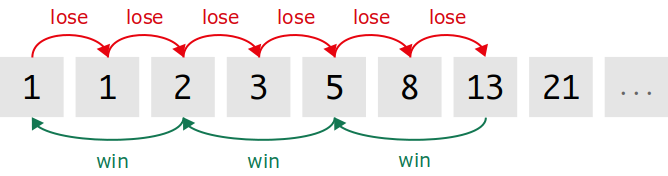
The Fibonacci betting system is a negative progression strategy based on the famous Fibonacci sequence. The core idea of the strategy is to increase the stake of your bet whenever you lose following a sequence where each number is the sum of the two preceding ones: 1, 1, 2, 3, 5, 8, 13, 21, 34, 55, 89, and so on.
Gamblers adapted this mathematical sequence into a betting strategy by using the numbers to determine bet sizes. Unlike the Martingale system, which doubles bets after losses, the Fibonacci system increases stakes more gradually, following the sequence’s natural progression. It has a much gentler curve than other negative progression systems such as the D’Alembert, which makes it a good choice for players who wish to avoid exposing themselves to too much risk.
The system’s main appeal is that it offers a simple progression that can be memorized even by complete beginners. Crucially, the stake increases aren’t exponential like in the Martingale. Where Martingale might have you betting 32 units after five losses, Fibonacci would only have you at 8 units. This counteracts one of the main pitfalls of Martingale, which is the small but real chance that your stake grows too quickly for your bankroll to keep up.
Of course, like any betting system, the Fibonacci gambling strategy still has severe limitations. For starters, it cannot reduce or overcome the house advantage, and it cannot increase your chances of winning.
Core Rules: Step-by-Step Guide
The Fibonacci betting system follows a straightforward set of rules that dictate how you move through the sequence.
Start by splitting your bankroll into a lot of equal units. Most players take 1% or 2% of their bankroll as a single Unit.
Then, follow these simple steps:
- Start at the beginning: Begin your betting sequence with the first number in the Fibonacci sequence (typically 1 unit). This represents your base bet.
- After a loss: Move one step forward in the sequence. If you lose a bet of 1 unit, your next bet becomes 1 unit (the second number). Lose again, and your next bet is 2 units. Continue progressing: 3, 5, 8, 13, and so on with each subsequent loss.
- After a win: Move two steps backward in the sequence. This is the key distinguishing feature of Fibonacci. If you’re betting 13 units and win, you move back two positions to 5 units (from 13 → 8 → 5).
- Reset condition: When you win and moving back two steps would take you below the start of the sequence, reset to your base bet of 1 unit and begin again.
Like most betting systems, this strategy is intended to work with even money bets. This means that you make wagers that pay 1:1 and have a roughly 50% chance to win.
To illustrate how the strategy works in action, let’s go through six rounds of a simulated game of roulette and see how the Fibonacci system affects our betting:
Notice how after the win on spin 4, we moved back two positions (from 4th to 2nd in the sequence).
After another win on spin 5, moving back two steps would take us to position zero, so we reset to the beginning instead.
This example demonstrates the system’s self-correcting nature—two wins were enough to erase the losses from three consecutive losing bets.
Applying Fibonacci to Roulette
The Fibonacci betting system can be used with any even money bet with a 1:1 payout and a roughly 50/50 shot at winning. However, its most common use case is as a mathematical roulette strategy.
Importantly, you can only use Fibonacci in roulette if you’re playing even money bets. These include red/black, odd/even, and high/low (1-18 or 19-36) wagers.
The system assumes you’ll win roughly half your bets. With even-money roulette wagers, you win 18 out of 37 spins on European roulette (48.6%) or 18 out of 38 on American roulette (47.4%). While not exactly 50%, these probabilities are close enough for the system to function as designed.
You can use the system for any common variant of roulette, including American. However, we strongly recommend sticking to European wheels:
| Feature |
European Roulette |
American Roulette |
| Zero Pockets |
1 (single zero) |
2 (0 and 00) |
| House Edge |
2.70% |
5.26% |
| Even-Money Win Probability |
48.65% |
47.37% |
| Fibonacci Performance |
Better |
Worse |
In short, all bets in European roulette win slightly more often. This results in better long-term profits.
As such, we strongly advise all players to avoid American roulette whenever possible, regardless of their strategy.
The Role of Zero
When the ball lands on zero (or double zero in American roulette), all even-money bets lose. This is the source of the house edge and represents a crucial reality check for any betting system.
The Fibonacci progression doesn’t protect you from the zero—it’s simply treated as a loss, causing you to move one step forward in the sequence.
Some players mistakenly believe that betting systems can overcome the house edge. They cannot. The zero ensures that over the long run, the casino maintains its mathematical advantage regardless of how you structure your bets. The Fibonacci system is a bankroll management tool, not a profit guarantee.
To find out more about the house advantage in roulette and why it’s impossible to overcome, you can check out our guide to odds in roulette.
Variations
While the standard Fibonacci system has you moving forward on losses and back two positions on wins, several variations exist that modify these core mechanics.
Standard vs. Full Reset Variant
The most common variation concerns what happens after a win:
- Step Back Two (Standard): This is the classic Fibonacci approach we’ve discussed. After each win, you move two positions back in the sequence. This creates a gradual recovery pattern where consistent alternating results (win-loss-win-loss) slowly move you toward profitability.
- Full Reset Variant: Some players prefer to reset completely to the beginning of the sequence after any win. This more conservative approach means you only risk progressing through the sequence during losing streaks, immediately returning to your base bet whenever you win.
The standard approach is generally superior because it allows you to recover losses more efficiently. The full reset variant is safer but makes it harder to overcome previous losses.
Reverse Fibonacci System
The Reverse Fibonacci flips the strategy on its head, turning it into a positive progression system:
- After a win: Move one step forward in the sequence (increase your bet)
- After a loss: Move two steps backwards in the sequence (decrease your bet)
This variation attempts to capitalize on winning streaks rather than recover from losing ones.
The logic is appealing: you increase bets when you’re winning and cut them when you’re losing. However, the Reverse Fibonacci suffers from a fatal flaw—it requires longer winning streaks than the standard version requires losing streaks to achieve the same profit potential.
Most experienced players stick with the standard Fibonacci for this reason. The Reverse version might seem psychologically appealing, but it’s largely less effective for even-money casino bets.
We’ll illustrate the progression in the table below:


























 Roulette
 Blackjack
 Baccarat
 Poker
Poker
 Sic Bo
 Dragon Tiger
 Game Shows
  Top 5 Games
  See more
  Roulette Casinos
  Low Limit
  High Limit / VIP
  Exclusive
  How to Play
  Basic Strategy
  Top Tips
  FAQ
FAQ  Blackjack Casinos
  Baccarat Casinos
  Bonuses
  Poker Casinos
  Game Providers
  Sic Bo Casinos
  Dragon Tiger Casinos
  Credit and Debit Card
  e-Wallet
  Cryptocurrency
  Bank and Checks
  Pay by Phone and SMS
  See more
  How-To Guides
  Top Lists
  In-Depth
  Strategy
  Casino & Games
  Insight
  News
News  Promotions
 Guide to Live Casinos
  Top 10 Live Casino Tips
  Studio Locations
  FAQ & Help
  Meet The Dealers
  Our Awards
  How We Rate
  Responsible Gambling


 ENG
ENG 







 Stick to Your Guns
 Facebook
 Pinterest
 Twitter
 LinkedIn
 Copy Link