Labouchere cannot change roulette probability or expected value. Each stake on a standard European even-money bet wins on 18 of 37 pockets and loses on 19. The 2.70% house edge applies to every dollar wagered, including the larger bets created later in the line.
The main risk comes from the gap between the original target and the funds required to keep the cancellation process alive. More available money can make completion more likely while increasing the amount exposed during an unsuccessful session.
What happens during a losing run
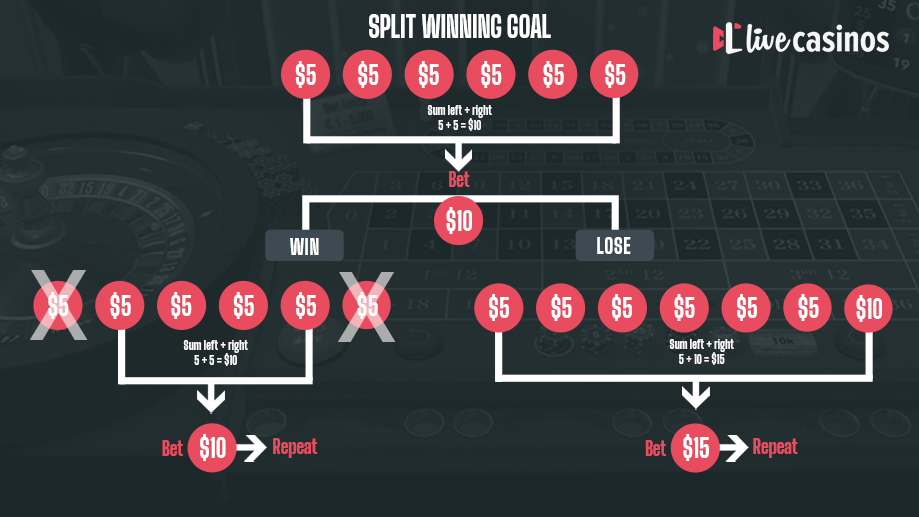
Starting with 1, 2, 3, 4, each straight loss adds the previous stake to the right side. The first value remains 1, so the next bet increases by one unit after each loss. The individual stakes grow linearly on this particular path, while cumulative loss grows much faster.
| Consecutive loss |
Outside values before bet |
Stake |
Stake at $5 per unit |
Cumulative loss |
| 1 |
1 + 4 |
5 units |
$25 |
$25 |
| 2 |
1 + 5 |
6 units |
$30 |
$55 |
| 3 |
1 + 6 |
7 units |
$35 |
$90 |
| 4 |
1 + 7 |
8 units |
$40 |
$130 |
| 5 |
1 + 8 |
9 units |
$45 |
$175 |
| 6 |
1 + 9 |
10 units |
$50 |
$225 |
| 7 |
1 + 10 |
11 units |
$55 |
$280 |
| 8 |
1 + 11 |
12 units |
$60 |
$340 |
The original profit goal is $50, yet eight straight losses cost $340 and leave a $65 next bet. Other win-loss paths change both ends of the list and can create a different progression. Straight-loss probability alone cannot describe the chance that a full Labouchere session reaches its limit.
What large simulations show
A Labouchere simulation by Michael Shackleford tested billions of sessions with a 10-unit profit goal. The results below compare three bankrolls on single-zero and double-zero roulette.
| Starting bankroll |
Single-zero sessions reaching +10 |
Single-zero expected result |
Double-zero sessions reaching +10 |
Double-zero expected result |
| 50 units |
79.52% |
-2.291 units |
75.45% |
-4.729 units |
| 250 units |
94.41% |
-4.527 units |
92.23% |
-10.204 units |
| 1,000 units |
98.33% |
-6.877 units |
97.34% |
-16.843 units |
More bankroll produces a higher chance of reaching the small goal before funds run out. It also produces a worse expected loss because unsuccessful sessions can consume a larger balance. The ratio of money lost to total money wagered stays close to the underlying house edge.
A separate simulation study of Labouchere reached the same broad conclusion: steady small returns can continue until a critical sequence exceeds the capital available. Our mathematical roulette strategy guide explains expected value and bankroll paths across several approaches.
European, American, and French roulette
| Wheel or rule |
Even-money win probability |
Treatment of zero |
House edge |
| European, single zero |
48.65% |
Full loss |
2.70% |
| American, 0 and 00 |
47.37% |
Full loss on 0 or 00 |
5.26% |
| European with La Partage |
48.65% |
Half of eligible stake returned |
1.35% |
La Partage reduces the cost of zero while leaving the chance of a full win at 18/37. If zero returns half the stake, append only the amount lost when following the cancellation logic. This may create half-unit values. Under En Prison, leave the list unchanged while the wager is held. Keep it unchanged if the stake is returned without profit, or append the full amount if the wager loses. Exact table rules take priority.
Use our roulette odds guide for the probability calculations and our La Partage and En Prison comparison for the special zero rules.
Reverse Labouchere
Reverse Labouchere swaps the reactions. A win adds the successful stake to the right side of the list. A loss removes the first and last values. The progression increases exposure during a winning run and contracts after losses.
The reverse version changes the distribution and timing of the stakes. It retains the same house edge on each roulette wager. Set a stop point because a winning run can lengthen the list and make the next bet much larger before a later loss arrives.
Compare the cancellation system with Martingale, Fibonacci, and other progressions in our roulette betting systems guide.
Labouchere pros and cons
| Pros |
Cons |
The written list makes each stake traceable.
The initial profit target is defined before play.
Different list designs can be tested in advance.
A fixed final stake or loss limit gives the session a measurable endpoint. |
The target does not reveal the bankroll required.
Losses lengthen the list and raise total exposure.
Bankroll and table limits can end the sequence.
Tracking errors change later stakes.
The expected value remains negative. |
Setting a finite Labouchere test
Write down the starting list, unit value, selected even-money bet, profit target, session bankroll, largest permitted stake, table minimum and maximum, and session loss limit. Test several possible result paths before placing the first wager.
Do not change the list to recover faster after a loss. Do not place a partial version of the next stake after reaching a limit, since that creates a different system. End the sequence and record it as unfinished.
Our risk of ruin calculator can illustrate how starting funds and loss limits affect session survival. It cannot turn a negative-expectation progression into a profitable method.
Labouchere is built around canceling losses and may encourage continued play. Stop if the list creates pressure to exceed the written limit, borrow, or use money needed for essential spending.
FAQ
What is the Labouchere system?
Labouchere is a cancellation-based staking progression. The player writes a list, bets its first and last values, removes them after a win, and adds the lost stake after a loss.
Does Labouchere work in roulette?
Clearing the line produces the selected profit target when every required wager can be placed. Some sessions reach a bankroll or table limit first. Repeated play keeps roulette’s negative expected value.
Do you need to win only one third of the bets?
A win removes two entries while a loss adds one, so a win rate above one third tends to shorten the list. The dollar values can still rise, and a finite bankroll may run out before the list is cleared.
Which roulette bets fit Labouchere?
Classic Labouchere uses 1:1 outside bets: red/black, odd/even, or low/high. Other roulette wagers have different payouts and require a modified cancellation calculation.
How much bankroll does Labouchere require?
No fixed multiplier applies to every list because the requirement depends on its values and the order of results. Calculate several loss paths and set a hard session cap. The starting list total shows the profit target.
What happens when zero lands?
Zero is a full loss on a standard table, so the lost stake is added to the list. La Partage returns half of an eligible even-money stake, while En Prison holds it for another spin. Record the exact amount lost or wait for resolution under the applicable rule.
Is Reverse Labouchere safer?
Reverse Labouchere reduces the list after losses and extends it after wins. It changes when larger stakes appear, while the probability and house edge of each roulette bet stay the same.
Verdict
The Labouchere system turns a profit goal into a visible cancellation list. That makes every decision easy to audit, but the original list total reveals little about the money required to finish an unfavorable path.
Large simulations explain the attraction. With more starting funds, most tested sessions reach a small goal. Their average result still falls below zero because the sessions that fail lose far more, and a larger bankroll gives those failures more room to develop.
Use a single-zero or eligible French table, calculate several paths, choose a maximum stake and session loss limit, and end the test when either is reached. Our live roulette strategy guide covers broader bet selection and session planning. Support and account-control resources are available on the responsible gambling page.


























 Roulette
 Blackjack
 Baccarat
 Poker
Poker
 Sic Bo
 Dragon Tiger
 Game Shows
  Top 5 Games
  See more
  Roulette Casinos
  Low Limit
  High Limit / VIP
  Exclusive
  How to Play
  Basic Strategy
  Top Tips
  FAQ
FAQ  Blackjack Casinos
  Baccarat Casinos
  Bonuses
  Poker Casinos
  Game Providers
  Sic Bo Casinos
  Dragon Tiger Casinos
  Credit and Debit Card
  e-Wallet
  Cryptocurrency
  Bank and Checks
  Pay by Phone and SMS
  See more
  How-To Guides
  Top Lists
  In-Depth
  Strategy
  Casino & Games
  Insight
  News
News  Promotions
 Guide to Live Casinos
  Top 10 Live Casino Tips
  Studio Locations
  FAQ & Help
  Meet The Dealers
  Our Awards
  How We Rate
  Responsible Gambling


 ENG
ENG 







 Calculate the Bankroll Separately
 Facebook
 Pinterest
 Twitter
 LinkedIn
 Copy Link