Roulette wheel numbers explained: Count, order, and layout
Roulette wheel numbers run from 1 through 36, with 37 total pockets in European single-zero roulette, 38 in American double-zero roulette, and 39 on a common triple-zero wheel. The remaining pocket labels are one, two, or three green zeros. When people ask how many numbers are on a roulette wheel, they usually mean the total number of pockets, so the short answers are 37, 38, or 39 depending on the variant.
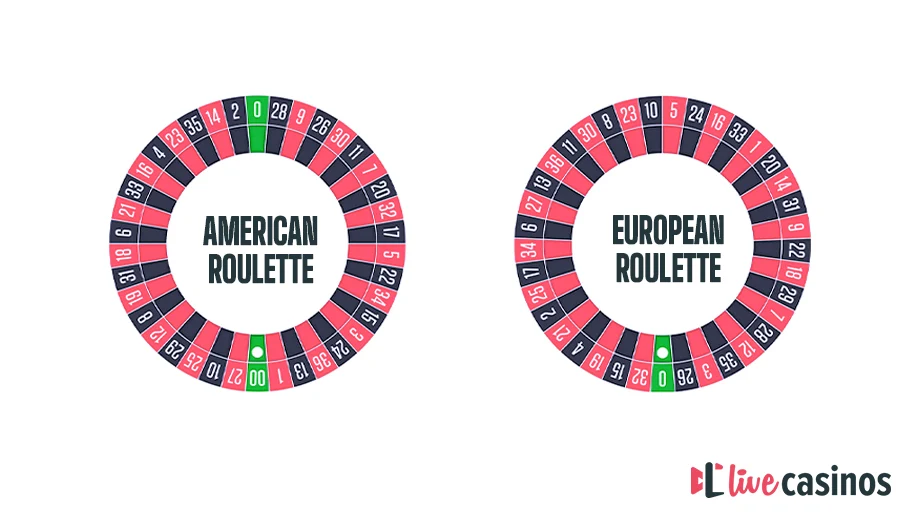
Those pockets do not run from 0 to 36 in numerical order. European and American wheels use different fixed sequences around the rotor, even though the red and black numbers from 1 to 36 keep the same colors. The circular wheel order also differs from the rectangular betting grid. Two numbers can sit side by side on the table and be far apart on the wheel.
This guide gives the complete clockwise and counterclockwise roulette wheel number orders, the red and black number lists, the layout around zero, physical neighbor examples, and the rule for opposite positions. For the effect that one or more zero pockets has on probability and house edge, use our separate American vs European roulette comparison.
European roulette has 37 pockets and American roulette has 38. Both use numbers 1–36, but their fixed wheel orders differ, while zero pockets are green.
Table of Contents
Table of Contents
How many numbers are on a roulette wheel?
All standard roulette wheels use the 36 positive integers from 1 through 36. The variant is identified by the green zero pockets added to those numbers. A single-zero wheel has 37 total pockets, a double-zero wheel has 38, and a triple-zero wheel has 39.
This wording creates a small counting trap. A European wheel is often described as having “numbers 0 to 36,” which is 37 values when zero is counted. An American wheel still has numbers 1 to 36, but 0 and 00 are separate pockets. The symbols 00 and 000 are labels for extra zero pockets, not the integers one hundred or one thousand.
Wheel type
Total pockets
Positive numbers
Green zero pockets
Quick identifier
European / single-zero
37
1–36
0
One green pocket
American / double-zero
38
1–36
0 and 00
Two green pockets on opposite sides
Common triple-zero
39
1–36
0, 00, and 000
Three green pockets
European roulette has one zero pocket; American roulette adds 00 and uses a different number order.European roulette has one zero pocket; American roulette adds 00 and uses a different number order.
The table answers the count question without turning this page into a probability guide. The additional zero pockets change the game math, so readers comparing odds and rules should continue to the European and American roulette guide.
European roulette wheel number order
A European roulette wheel has 37 pockets. Zero is green, while the 36 numbered pockets alternate red and black around the rotor. In the convention used below, imagine looking down at the wheel from above, start at 0, and move clockwise around the numbered ring.
The pockets immediately beside 0 are 26 and 32. Other useful anchor points include the run 10, 5, 24 on one side of the wheel and 12, 35, 3 on the other. These are physical neighbors even though the values are not numerically close.
European single-zero wheel layout. Always check the stated starting point and direction when comparing sequence diagrams.
American roulette wheel number order
An American roulette wheel has 38 pockets: 1 through 36, 0, and 00. The two green zero pockets sit on opposite sides of the rotor. The remaining numbers use a sequence that is completely different from the European order.
On this wheel, 0 sits between 2 and 28. Double zero sits between 1 and 27. A player who memorized the European zero area would read an American wheel incorrectly, even though both wheels display the same numbers from 1 to 36.
Triple-zero roulette wheel number order
A common triple-zero wheel has 39 pockets. One widely used arrangement starts with 0, 000, and 00, then continues through the single-zero sequence. Starting at 0 and moving clockwise in that convention:
Triple-zero and promotional formats deserve an extra check because a provider can use a specialty wheel or a digital presentation that does not match the common arrangement above. Read the wheel shown in the game and its help file before relying on a memorized sequence.
Roulette wheel numbers and colors
The color assigned to each number from 1 to 36 is the same on European and American roulette. There are 18 red numbers and 18 black numbers. Zero, double zero, and triple zero are green where those pockets exist.
0; 0 and 00; or 0, 00, and 000, depending on the variant
Around both standard wheel sequences, the numbered pockets alternate red and black. Green zero pockets interrupt that sequence. Parity and range do not follow the same simple alternation: odd can sit beside odd, even beside even, and two high or low numbers can be neighbors.
Zero labels belong to neither color bet, parity group, nor 1–18/19–36 range. In other words, 0, 00, and 000 are green, neither odd nor even, and neither high nor low. The complete effect on individual bets belongs in our guide to roulette bets.
Why are roulette wheel numbers in that order?
The order jumps across the numerical range instead of counting upward. The final layout gives every numbered pocket a red or black neighbor, while odd/even and low/high values are spread across the rotor rather than placed in one large block. Those are observable properties of the standard sequence.
The historical reason for every position is less certain. A common explanation says the sequence was designed to balance color, parity, and range across sectors. That description fits parts of the layout, but there is no well-documented formula that generates the complete European sequence or proves the intended reason for every pocket. It is more accurate to describe the pattern we can verify than to claim a detailed design story that surviving evidence does not establish.
The American sequence has a more obvious opposite-position rule. Its 38 pockets allow exact pairs across the center: 0 faces 00, and each odd number faces the next higher even number. That rule explains much of the double-zero arrangement, though it does not turn the sequence into a predictor of the next result.
The sequence describes position, not probability
A fixed wheel order tells you which pockets are adjacent or opposite. It does not make a number due, change its chance on the next fair spin, or turn recent results into a forecast.
Roulette wheel layout vs roulette table layout
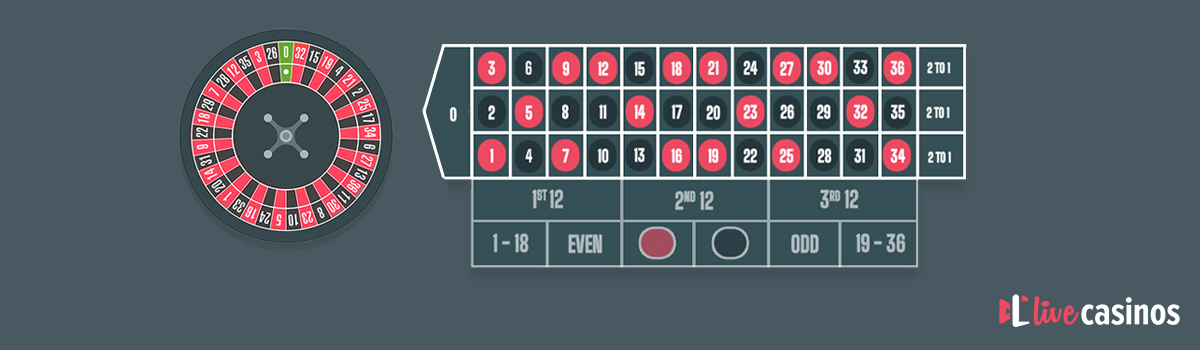
The wheel and the betting table contain matching result labels, but they organize those labels for different jobs. The wheel is circular because the ball must settle in one physical pocket. The table is a grid because players need clear places for single-number and combination bets.
Feature
Wheel / racetrack
Betting table / grid
Main purpose
Shows physical pocket positions around the rotor
Shows where chips are placed
Order
Fixed European, American, or specialty sequence
1–36 in twelve rows of three, with zero area attached
Meaning of adjacent
Pockets immediately beside one another on the rotor
Betting boxes sharing an edge or corner, depending on the wager
Example for 5
European wheel neighbors are 10 and 24
The grid places 5 among 2, 4, 6, and 8
This distinction explains why a wheel neighbor selection cannot be reconstructed by choosing nearby numbers on the cloth. It also explains the racetrack panel used in many online and live-dealer games. The racetrack is a compact picture of the circular sequence, while the main table follows numerical rows and columns.
How to read a roulette wheel diagram
Identify the zero pockets. One zero indicates the standard European sequence, while 0 and 00 indicate the standard American sequence. Three zero symbols usually indicate a specialty or triple-zero layout.
Check the starting pocket. Sequence lists usually start at 0, but a circular layout has no true first number. The chosen start only makes the list easier to write.
Check the direction. “Clockwise” and “counterclockwise” must be stated. A reverse list can be correct for the same wheel.
Use a top-down viewpoint. A camera image, mirrored graphic, or dealer-facing diagram can appear reversed. Match the zero area and its immediate neighbors before comparing the full list.
Separate rotor position from spin direction. The wheel can rotate in either direction during play. The printed pocket sequence on the rotor remains fixed.
A quick verification is more reliable than checking all 37 or 38 entries. On a European wheel, 0 must sit between 26 and 32. On an American wheel, 0 must sit between 2 and 28, while 00 must sit between 1 and 27. If those anchors do not match, the source may be reversed, mirrored, or showing another layout.
Roulette wheel neighbors lookup
A number’s immediate wheel neighbors are the pockets directly to its left and right in the fixed sequence. They are not the same as nearby values or neighboring boxes on the betting grid.
Pocket
European immediate neighbors
American immediate neighbors
0
26 and 32
2 and 28
00
Not present
1 and 27
5
10 and 24
17 and 22
17
25 and 34
32 and 5
32
0 and 15
20 and 17
36
13 and 11
24 and 13
These examples show why the wheel type must be known before any physical neighborhood is described. Number 5 borders 10 and 24 on a European wheel, but 17 and 22 on an American wheel.
What number is opposite zero?
No single pocket is exactly opposite 0 on a European wheel. A 37-pocket circle has an odd number of equal positions, so the point 180 degrees from the center of one pocket falls between two pockets on the other side. For European zero, that opposite point lies at the boundary between 5 and 10.
An American wheel has 38 pockets, an even number, so every pocket has one exact opposite pocket. Zero sits opposite 00. The rest of the wheel follows a simple rule: every odd number is opposite the next higher even number.
American opposite pairs
American opposite pairs
American opposite pairs
0 ↔ 00
1 ↔ 2
3 ↔ 4
5 ↔ 6
7 ↔ 8
9 ↔ 10
11 ↔ 12
13 ↔ 14
15 ↔ 16
17 ↔ 18
19 ↔ 20
21 ↔ 22
23 ↔ 24
25 ↔ 26
27 ↔ 28
29 ↔ 30
31 ↔ 32
33 ↔ 34
35 ↔ 36
Not applicable
Not applicable
A 39-pocket triple-zero wheel also has an odd number of positions, so it cannot give every pocket one exact diametric partner. When an article names a single “opposite number” on a 37- or 39-pocket wheel, it is usually simplifying an opposite area or choosing one of the two nearest pockets.
How wheel sectors relate to the number order
Named sectors and neighbor selections are built from physical arcs of the single-zero wheel. They use the circular order shown above, which is why the groups appear scattered when copied onto the 3 × 12 betting grid. The racetrack interface lets a player select those wheel areas without memorizing every table position.
This page stops at that relationship. For exact chip counts, covered numbers, placement maps, result profiles, and explanations of Voisins du Zéro, Tiers du Cylindre, Orphelins, Jeu Zéro, and Number and Neighbors, use our roulette sector bets guide.
What memorizing the roulette order can and cannot do
Memorizing a wheel sequence can make a layout easier to read. It can help a dealer, student, or player identify immediate neighbors, follow a racetrack interface, or check whether a graphic shows a single-zero or double-zero wheel. It does not alter the chance of a fair pocket winning.
It can help you
It cannot reliably do
Identify the wheel variant from the zero area
Predict the next winning number
Find immediate physical neighbors
Make a missing number due
Understand racetrack and sector placement
Change a pocket’s stated probability
Check whether a diagram is reversed or mirrored
Prove wheel bias from a short result history
A fixed sequence can still matter in a physical analysis because a pocket’s position is part of the wheel. That is a different subject with a much higher evidence threshold. Our roulette wheel physics and bias guide explains why visible order, recent results, and genuine mechanical bias must not be treated as the same thing.
A practical way to learn the sequence
Choose one wheel first. Do not learn European and American sequences at the same time.
Anchor the zero area. European: 26, 0, 32. American: 2, 0, 28 and 1, 00, 27.
Learn short chunks. Groups of three to six pockets are easier to verify than one unbroken list.
Say the direction. Practice with “clockwise from zero” or “counterclockwise from zero” so the reverse order is not mistaken for an error.
Test neighbors as well as the whole list. Pick a pocket and name the number on each side. This builds a usable mental map.
Compare with the real game. Check the zero anchors before using the sequence on a live interface or diagram.
Common roulette layout mistakes
Mistake
Correct reading
Calling 1–36 a 36-pocket European wheel
The green 0 adds a 37th pocket.
Treating 00 or 000 as ordinary positive integers
They are labels for separate green zero pockets.
Assuming European and American wheels share one order
They use different standard sequences.
Using table neighbors as wheel neighbors
Check the circular rotor or racetrack sequence.
Calling a reversed list wrong
Confirm the stated direction and viewpoint.
Naming one exact opposite pocket on a European wheel
With 37 pockets, each pocket faces a gap between two pockets.
Assuming a memorized layout predicts results
Position knowledge does not change independent-spin probability.
Roulette wheel numbers FAQ
How many numbers are on a European roulette wheel?
A European roulette wheel has 37 pockets: the numbers 1 through 36 and one green 0. People often call all 37 pocket labels “numbers,” even though zero is counted alongside the 36 positive numbers.
How many numbers are on an American roulette wheel?
An American roulette wheel has 38 pockets: 1 through 36, a green 0, and a green 00. The 00 symbol is a separate zero pocket and does not mean the number one hundred.
Are roulette wheel numbers in the same order everywhere?
Standard European single-zero wheels share one familiar sequence, while standard American double-zero wheels share another. A diagram can look reversed when read in the opposite direction or from another viewpoint. Triple-zero, promotional, and custom formats should be checked individually.
What color is each roulette number?
Numbers 1–36 are split into 18 red and 18 black values, using the same assignments on European and American wheels. Zero pockets are green. The full red and black lists appear in the table above.
Are 0 and 00 odd or even?
No. Roulette zero pockets are neither odd nor even. They also belong to neither 1–18 nor 19–36. Their treatment for a particular wager can depend on the rules, which should be checked in the game’s help file.
What number is directly opposite 0 on a European wheel?
There is no single number directly opposite 0 because a European wheel has an odd total of 37 pockets. The diametric point from the center of 0 falls between pockets 5 and 10.
What number is opposite 0 on an American wheel?
Double zero is directly opposite 0 on the standard 38-pocket American wheel. Every odd number is also opposite the next higher even number, such as 1 opposite 2 and 35 opposite 36.
Why do the numbers on a roulette wheel add up to 666?
The sum of the integers from 1 through 36 is 666: 36 × 37 ÷ 2 = 666. Zero pockets add nothing to that total. The result follows from the arithmetic-series formula and has no effect on the wheel, odds, or outcome.
Does knowing the roulette number order improve the odds?
No. Knowing the order helps you read physical neighbors, opposite areas, and racetrack selections. On a fair game, it does not increase the chance that a chosen pocket wins or make recent misses predictive.
Verdict
The answer to “how many numbers are on a roulette wheel?” depends on the zero pockets: 37 on European roulette, 38 on American roulette, and 39 on a common triple-zero wheel. The numbers 1–36 keep the same red or black colors, but European and American rotors arrange them in different fixed sequences.
Use the wheel sequence to identify physical positions, read a racetrack, and avoid confusing rotor neighbors with table-grid neighbors. Do not treat that map as a prediction system. Each accepted spin still has to be read under the published rules of the specific game. Keep roulette spending within a fixed entertainment budget, and use the limits and support options in our responsible gambling guide if play becomes difficult to control.
Janko is the Technical Reviewer at LiveCasinos. He plays and documents every game we cover, checking rules, payouts and sequences against the provider's own rules pages before a review goes live.
You’ll be the first to know about our latest offers, exclusive bonuses, tips and promotions. Well, you know what to do...
If you subscribe you confirm you are 18+ and you accept to receive marketing material. To see how we may use your information, take a look at our Privacy Policy.
LiveCasinos.com Cookies
To make your experience using LiveCasinos better, our site uses cookies. By continuing to use this website, you agree to our use of cookies, which is further described in our Cookie Policy.

























 Roulette
 Blackjack
 Baccarat
 Poker
 Sic Bo
 Dragon Tiger
 Game Shows
 Top 5 Games
 See more
 Roulette Casinos
 Low Limit
 High Limit / VIP
 Exclusive
 How to Play
 Basic Strategy
 Top Tips
 FAQ
 Blackjack Casinos
 Baccarat Casinos
 Bonuses
 Poker Casinos
 Game Providers
 Sic Bo Casinos
 Dragon Tiger Casinos
 Credit and Debit Card
 e-Wallet
 Cryptocurrency
 Bank and Checks
 Pay by Phone and SMS
 See more
 How-To Guides
 Top Lists
 In-Depth
 Strategy
 Casino & Games
 Insight
 News
 Promotions

 Guide to Live Casinos
 Top 10 Live Casino Tips
 Studio Locations
 FAQ & Help
 Meet The Dealers
 Our Awards
 How We Rate
 Responsible Gambling


 ENG






 The sequence describes position, not probability
 Facebook
 Pinterest
 Twitter
 LinkedIn
 Copy Link