Roulette betting systems use fixed instructions to determine the next stake or arrange several bets on the layout. Martingale doubles after a loss, Paroli doubles after a win, Fibonacci follows a number sequence, and Romanosky spreads a fixed stake across 32 numbers.
Each method creates a different pattern of wins, losses, and required stakes. The probability of the ball landing on a selected number stays fixed. This guide compares eight popular systems by their rules, stake growth, session risk, and the point at which a real bankroll or table limit can interrupt the plan.
A roulette system can change the size and timing of your wagers. The wheel probabilities and house edge remain tied to the selected game and bets, so every progression needs a maximum stake and stopping point.
Table of Contents
Table of Contents
Roulette Betting Systems Compared
The word system covers several approaches. Progression systems react to the previous result by changing the next stake. Flat betting keeps the unit unchanged. Coverage methods such as Romanosky place several fixed bets during the same spin.
These categories create different bankroll paths:
Positive progression: the stake rises after a win. Paroli and Oscar’s Grind fit this category, though their reset rules differ.
Negative progression: the stake rises after a loss. Martingale, D’Alembert, Fibonacci, and Labouchere use different growth patterns.
Flat betting: the same total stake is used each round, making exposure easier to follow.
Fixed coverage: several positions are combined to create a chosen hit rate and payout profile. Romanosky is a well-known example.
System
Type
Rule for the next stake
Growth pattern
Main pressure point
Flat betting
Fixed stake
Repeat the same unit
None
Losses accumulate over repeated play
Martingale
Negative progression
Double after a loss
Exponential
A short losing run can demand a very large bet
Paroli
Positive progression
Double after a win
Exponential within a capped cycle
A late loss can erase the earlier cycle wins
D’Alembert
Negative progression
Add one unit after a loss and remove one after a win
Linear
Recovery can require a long favorable sequence
Fibonacci
Negative progression
Move forward after a loss and back two places after a win
Sequence growth
Later positions require large stakes
Labouchere
Negative progression
Bet the first and last numbers in a written line
Variable
The line and required stake can grow after losses
Oscar’s Grind
Positive progression
Hold after a loss and add one unit after a win
Linear within a cycle
A difficult cycle can become long and expensive
Romanosky
Fixed coverage
Repeat four bets totaling eight units
None
One uncovered result loses all eight units
A slower progression may look gentler because each individual increase is smaller. The total deficit can still become substantial when a losing period continues. The relevant comparison includes the largest required stake, cumulative amount lost before that stake, table maximum, and reset condition.
How quickly progression stakes grow
The table below applies Martingale, D’Alembert, and Fibonacci to the same six-loss sequence with a base unit of $5. Every method begins at the same point, while its progression rule creates a different level of exposure.
System
Six losing stakes
Lost after six bets
Next stake
Martingale
$5, $10, $20, $40, $80, $160
$315
$320
D’Alembert
$5, $10, $15, $20, $25, $30
$105
$35
Fibonacci
$5, $5, $10, $15, $25, $40
$100
$65
Martingale creates the largest immediate drawdown and next-step requirement. D’Alembert grows at a steady rate, while Fibonacci starts slowly and then accelerates. A later win has a different effect under each rule, so the figures above compare stake growth rather than recovery time or final profit.
A six-loss run is possible on any even-money bet. Its appearance does not show that the next spin is more likely to win. Use the table to size the progression against a real bankroll and table maximum.
How to evaluate a roulette system
Write the full rule set before judging the examples. A complete system should answer six questions:
Which roulette bets does it use?
What is the starting unit?
What happens after a win?
What happens after a loss?
When does the sequence reset?
What bankroll, stake, or time limit ends the sequence?
Systems that omit the final question often look stronger on paper because the example assumes the player can always place the next required wager. Real tables have maximums, and real bankrolls are finite.
Every spin remains independent. A progression can pair a larger or smaller stake with the next random result, producing a different bankroll path. It cannot increase the chance that the selected numbers win.
How Popular Roulette Systems Work
Positive progression roulette systems
A positive progression raises the wager after a win. The player risks a larger stake only after the current sequence has produced some profit. The tradeoff appears when one loss arrives late in the progression and removes several earlier gains.
Paroli
Paroli, also called Reverse Martingale, usually begins with an even-money bet. The player doubles after each win and resets after a loss or after reaching a preset number of consecutive wins, commonly three.
With a one-unit base, the stakes are 1, 2, and 4 units. Three wins produce seven units of profit. A loss on the second or third step leaves the sequence one unit down. The cap matters because continued doubling would expose an increasing share of the accumulated profit.
Rule after a win: double the next stake.
Rule after a loss: return to one unit.
Common reset: three consecutive wins.
Main risk: the final loss can erase the earlier wins in that cycle.
Oscar’s Grind
Oscar’s Grind uses cycles that seek one unit of profit. The player repeats the stake after a loss and adds one unit after a win, without betting more than the amount needed to finish the cycle one unit ahead. A completed cycle then resets.
Its stake growth is slower than Paroli or Martingale. A cycle with repeated losses and intermittent wins can still become long, and the open deficit may be much larger than the one-unit target.
Negative progression roulette systems
A negative progression raises the stake after a loss. The usual aim is to recover part or all of the preceding deficit when the selected bet next wins. The danger grows with the losing run because each increase puts more money into the same negative-expectation wager.
Martingale
Martingale doubles the stake after every loss and returns to the base unit after a win. If every required wager can be placed, a later even-money win recovers the earlier losses and leaves one base unit of profit.
The required stakes grow exponentially. Starting at $5, six losses use stakes of $5, $10, $20, $40, $80, and $160. The cumulative loss is $315, and the seventh wager must be $320. A bankroll below $635 or a table maximum below $320 stops that sequence before the planned recovery bet.
D’Alembert
D’Alembert adds one unit after a loss and removes one unit after a win. The wager grows linearly, making the individual jumps smaller than Martingale. Several losses still create a deficit that one later win cannot recover.
The system is sometimes linked to the idea that wins and losses should balance inside a short session. Independent results have no schedule that forces such a correction. The slower stake growth changes the size of the drawdown without creating better wheel odds.
Fibonacci
The Fibonacci betting system uses the sequence 1, 1, 2, 3, 5, 8, 13, 21, and so on. A loss moves the stake one position forward. A win moves it two positions back.
The first increases are modest, but the later stakes become large during an extended losing run. Recovery may require several wins because a single winning wager does not always cover the accumulated deficit.
Labouchere
The Labouchere system begins with a written line of numbers. The next stake equals the first and last numbers in the line. A win removes those numbers, while a loss adds the lost stake to the end of the line.
The player completes the sequence when every number has been removed. A difficult run can extend the line and create large stakes, while one completed sequence usually earns only the sum of the original numbers. The player should set a maximum line length and stake before beginning.
Flat betting
Flat betting repeats the same unit on every spin. It does not seek to recover losses through later stake increases. The player can use it with an inside bet, outside bet, or fixed combination, provided the total amount wagered stays constant.
The main benefit is visibility. Ten spins at two units create 20 units of total action, regardless of their order. A progression requires a step-by-step calculation because the same ten results can produce very different stake totals depending on when the wins and losses occur.
Flat betting still carries the house edge and can lose the full session bankroll. It simply prevents the staking rule from accelerating the wager after a result. Our flat betting guide covers its use across several casino games.
The Romanosky roulette system
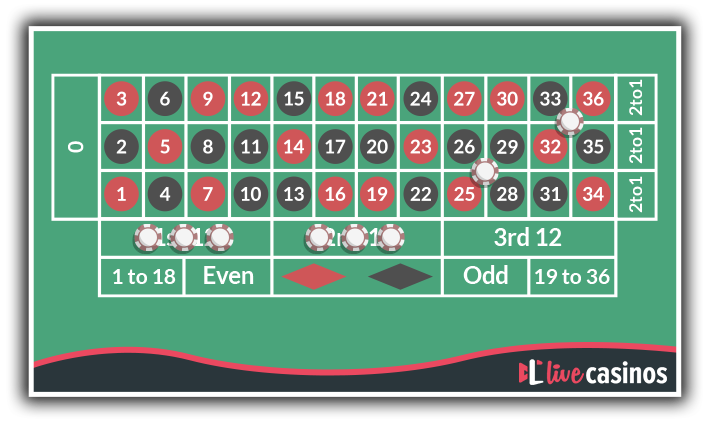
Romanosky, also spelled Romanovsky, is a fixed coverage method for a European single-zero wheel. It uses eight equal units across four bets:
three units on one Dozen;
three units on a second Dozen;
one unit on a Corner inside the remaining Dozen;
one unit on another non-overlapping Corner inside that remaining Dozen.
A Romanosky layout covers 32 of 37 numbers with eight units. The two Corner bets must cover eight different numbers outside the selected Dozens.
The four wagers cover 32 unique numbers. Any covered number returns nine units in total, leaving one unit of net profit from the eight-unit stake. The five uncovered numbers lose all eight units.
Romanosky outcome
European probability
Net result
Covered number wins
32/37, or 86.49%
+1 unit
Uncovered number wins
5/37, or 13.51%
-8 units
One losing result cancels eight one-unit wins. The high hit rate creates many small winning rounds and occasional losses that are eight times larger. Across standard European payouts, the complete eight-unit wager retains the usual 2.70% house edge.
Choosing between roulette systems
Start with the structure you want to study, then check its largest possible stake. Flat betting offers the clearest spending record. Paroli places larger bets after wins and can be capped at three steps. D’Alembert and Fibonacci grow more gradually after losses. Martingale reaches large stakes fastest. Labouchere and Oscar’s Grind organize play around a written sequence or cycle. Romanosky keeps the round stake fixed while trading eight-unit losses for frequent one-unit wins.
None of these descriptions identifies a system that can produce a positive expected value. A player can finish any individual session ahead, and different systems can make that result more or less volatile. The wheel type and payout schedule determine the mathematical cost attached to each dollar wagered.
Common mistakes when using a roulette system
Starting without a final step: every progression needs a largest permitted wager.
Ignoring cumulative loss: the money already lost matters as much as the size of the next bet.
Assuming a win is due: earlier results cannot improve the next-spin probability.
Overlooking table maximums: the casino may block the required recovery wager.
Judging by hit rate alone: Romanosky wins often because each losing result costs eight units.
Changing the rules mid-session: an improvised increase removes the spending boundary that made the system measurable.
Set the session loss limit, time limit, base unit, and largest stake before play. Use only money you can afford to lose. A written plan can make wagering easier to track, though it cannot make roulette a source of reliable income.
How to test a roulette betting system
A short winning example reveals very little about a staking plan. Test the complete rule set across many sequences and record the total amount wagered, largest stake, deepest drawdown, number of completed cycles, and reason each unfinished sequence stopped.
Write every rule: define the base unit, response to a win, response to a loss, reset point, and final permitted step.
Use one wheel model: keep the test on European or American roulette throughout, since their zero pockets produce different probabilities.
Apply the same results: compare systems against an identical sequence so a lucky path does not favor one method.
Include table limits: stop the test when the next required stake exceeds the chosen maximum.
Track total action: add every wager, including multiple chips placed during one Romanosky round.
Repeat the test: one sequence shows a possible result. Many independent runs reveal how widely outcomes can vary.
A free-play table can help confirm that the rules are easy to follow in real time. It cannot prove that the system is profitable. The strongest check is whether the written method remains usable when the unfavorable sequence it was designed to handle actually occurs.
FAQ
What is a roulette betting system?
It is a fixed set of rules for choosing the next stake or arranging several bets on the same spin. Progression systems react to wins or losses, while flat and coverage methods repeat a predetermined total wager.
What is the best roulette betting system?
No system removes the house edge. Flat betting gives the clearest view of total action and prevents automatic stake growth. Players comparing progressions should judge them by the largest required wager, cumulative drawdown, reset rule, and table-limit risk.
Can Martingale guarantee a profit?
No. Martingale requires exponentially larger wagers during a losing run. A finite bankroll or table maximum can stop the sequence before a recovery win arrives.
Are positive progression systems safer?
They usually reset after a loss, which can limit the size of one cycle. They still expose each wager to the house edge, and a loss late in a progression can remove the earlier cycle gains.
Does Romanosky really win 86% of roulette spins?
On a European wheel, a correctly placed Romanosky combination covers 32 of 37 numbers, producing an 86.49% hit rate. A covered result earns one unit, while any of the five uncovered numbers loses eight units. The high hit rate does not remove the 2.70% house edge.
Can I use betting systems on American roulette?
Progression rules can be applied, but the standard double-zero house edge is 5.26%, compared with 2.70% on a single-zero European wheel. Romanosky covers 32 of 38 American pockets if the same layout is used, lowering its hit rate to 84.21%.
Verdict
Roulette betting systems provide structure. Paroli and Oscar’s Grind increase stakes after favorable results, while Martingale, D’Alembert, Fibonacci, and Labouchere react to losses. Flat betting holds the unit steady. Romanosky combines four fixed wagers to create a high hit rate and an eight-unit downside.
The important figures are the largest required stake, cumulative loss before that step, reset condition, and total amount wagered. A system that looks calm across several rounds can still contain a large tail loss, especially when recovery depends on continued stake growth.
Choose a single-zero wheel where possible, calculate the full sequence, and set the stopping point before the first spin. For the wider table-selection and bankroll framework, return to our roulette strategy guide. If gambling becomes difficult to control, use the limits and support resources on our responsible gambling page.
Luka has been writing content for various sites and publications for the better part of a decade, which includes both iGaming and topics related to video games and technology. This experience gives him a unique perspective on what live casino games are, what they can be, and how they’ve grown and changed over the years. His love of gaming also ensures an in-depth understanding of most games you’re likely to find in a live casino lobby, and he enjoys discussing strategies and the maths and statistics that make these games tick.
You’ll be the first to know about our latest offers, exclusive bonuses, tips and promotions. Well, you know what to do...
If you subscribe you confirm you are 18+ and you accept to receive marketing material. To see how we may use your information, take a look at our Privacy Policy.
LiveCasinos.com Cookies
To make your experience using LiveCasinos better, our site uses cookies. By continuing to use this website, you agree to our use of cookies, which is further described in our Cookie Policy.