The term “high roller” gets thrown around quite a bit in casino marketing, but what actually counts as high-stakes play?
Definitions vary across the gambling industry, but understanding where you fall on the spectrum helps determine the appropriate bankroll management strategies for your level.
Industry insiders generally segment players into tiers based on average bet size:
- A player wagering $100-500 per hand represents the entry level of high-roller status—above recreational players but below the true whales who move markets.
- True high-rollers consistently bet $500-$10,000 per hand. These are true, undeniable high-rollers that most casinos would be eager to welcome.
- Ultra-high-rollers or “whales” operate at $25,000-$100,000+ per hand. At this extreme end, a handful of players worldwide regularly wager millions.
What’s critical to understand is that high-roller status isn’t about your net worth—it’s about your actual betting levels and exposure.
A millionaire betting $50 per hand isn’t a high-roller in operational terms, while someone with $500,000 in liquid assets betting $1,000 per hand absolutely qualifies.
The strategies in this guide apply to your betting behavior, not your bank account balance. Of course, you still need a sizeable bank account to fund a high-rolling career, but the term refers to your betting, not your assets.
Why High Rollers Need Different Strategies
High-stakes gambling operates under the same mathematical rules as low-stakes play. After all, high rollers play the same games, follow the same rules, adhere to identical math principles, and have more or less the same goals. For instance, the return-to-play rate of any given gambling game is the same regardless of whether you’re betting $1 or $10,000 per round.
However, the practical implications of these principles change dramatically.
Every percentage point of house edge gets magnified when you’re wagering thousands instead of tens. A 2.70% house edge on European roulette costs a $10 bettor $27 per hundred spins. That same edge costs a $1,000 bettor $2,700 per hundred spins—$27,000 per thousand spins.
The mathematics scale linearly, but the financial and psychological impact does not.
Think of it this way: a single session at a high-stakes table can swing six-figure amounts. A moderately unlucky blackjack session betting $2,000 per hand can easily result in a $60,000-80,000 loss over four hours.
This level of variance demands bankroll depth that recreational players never contemplate. It also creates psychological pressure that can cloud judgment and lead to catastrophic decision-making, like chasing losses or abandoning strategy out of frustration.
Additionally, high-stakes play brings complications that don’t affect smaller bettors. For example, VIP casino services and comps can change the maths behind your strategy – you’re not just evaluating game odds but also cashback percentages and comp value. Depending on your country of residence, tax reporting requirements can also kick in at certain thresholds, which further increases the importance of keeping track of your money.
Common Misconceptions About High-Roller Gambling
High-stakes gambling is surrounded by a lot of myths and misconceptions, often perpetuated by casino marketing or misunderstood by players themselves.
The first myth suggests that high-rollers can “afford to lose”, so bankroll management becomes optional – or at least less important. This misconception has bankrupted countless wealthy gamers. Being able to afford a loss doesn’t mean you should carelessly lose on purpose. In fact, it just means that not taking the time to make decisions will be even costlier. As any rich man will tell you – wealth doesn’t exempt you from financial discipline.
Another persistent myth claims that bigger bets somehow yield better odds, or that VIP players have access to games with a reduced house edge. However, this disregards how house advantage actually works in gambling. The mathematics of casino games are immutable. A $10,000 blackjack hand faces the same house edge as a $10 hand. Yes, high-rollers receive better comps, faster withdrawals, and personalized service—but these perks don’t alter the fundamental probability that you’ll lose money over time.
Perhaps the most damaging myth is that high-rollers are reckless gamblers who win and lose millions on gut instinct. While such players certainly exist, successful high-rollers – those who maintain their wealth despite regular gambling – are typically highly disciplined individuals who approach betting with sophisticated bankroll management and clear limits.
Remember – reckless whales make headlines; the disciplined high-rollers quietly enjoy sustainable high-stakes entertainment for years.
Core Principles of High-Roller Bankroll Management
Effective bankroll management for high-stakes gambling is based on several important principles, which can all help you play sustainably.
Principle 1: Separate Gambling Bankroll from Total Wealth
The cardinal rule of bankroll management at any level is never gambling with money you actually need. You’ve probably heard this piece of advice before as “never gamble something you’re not willing to lose.”
For high-rollers, this principle means that you should establish a dedicated gambling bankroll.
Realistically speaking, your budget should probably not exceed 1% of your liquid assets. While some say that 5% is the upper limit, for high-rollers, such a figure would probably translate to a lot of actual currency.
Keep gambling funds completely separated from personal accounts and portfolios. Use separate bank accounts, and more importantly, separate mental accounting. This gambling bankroll should be replenished only from disposable income—never by liquidating investments or dipping into principal.
If you lose your entire gambling bankroll, the proper response is probably to take a break from gambling for a while.
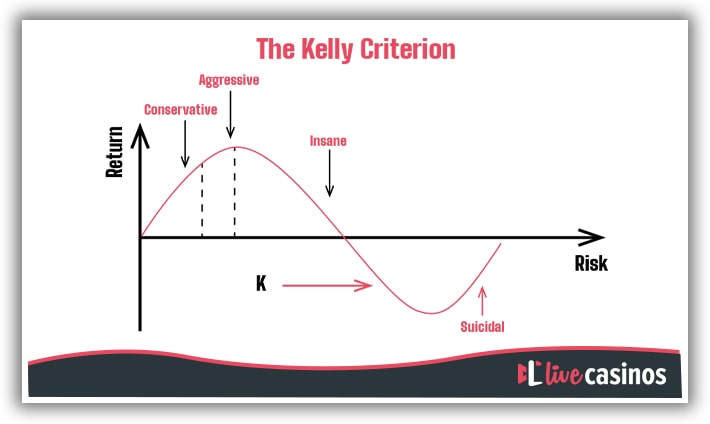
Principle 2: The Kelly Criterion and Bet Sizing
The Kelly Criterion is a mathematical formula that determines optimal bet sizing based on your edge and variance. For advantage players such as professional poker players, sports bettors with demonstrable edges, or card counters in blackjack, Kelly provides a framework for maximizing long-term bankroll growth while minimizing risk of ruin.
The formula is as follows:
f* = (bp – q) / b
Where f* is the fraction of bankroll to bet, b is the odds received on the bet, p is the probability of winning, and q is the probability of losing.
Don’t worry if this looks complex—the key insight is that Kelly tells you to bet larger when you have a bigger edge and smaller when your edge is marginal.
However, this principle has a major issue when it comes to real gambling: the Kelly Criterion doesn’t apply to negative-expectation games. In other words, if the game has a house edge (RTP under 100%), the mathematically optimal bet size is zero. As you’re probably aware, this applies to pretty much every game you can play at a casino. Card counting in blackjack is technically an exception, but it’s not a viable technique in most situations due to the casinos’ efforts to crack down on advantage play.
Since you’re presumably reading this guide because you want to gamble despite the mathematical disadvantage, the main takeaway is to bet small relative to your bankroll. If nothing else, you can use the criterion to figure out which bets are better than others – or at least which bets are less bad than others.
Principle 3: Session Bankrolls vs. Total Bankroll
Never bring your entire gambling bankroll to a single session. This fundamental mistake has cost countless high-rollers far more than necessary.
Instead, divide your total gambling bankroll into multiple session bankrolls, typically 10-20% of the total.
If your total gambling bankroll is $500,000, appropriate session bankrolls range from $50,000 to $100,000. This compartmentalization is important for more than one reason.
Firstly, it limits the damage from any single disastrous session—you can’t lose everything in one bad night.
Secondly, it creates clear psychological stopping points. When your session bankroll is depleted, you leave. No exceptions, no rationalizations, no “just one more buy-in.”
The session bankroll approach also helps track your overall spending. If you’re consistently losing entire session bankrolls, it will quickly become painfully obvious. This allows you to reassess your play before burning through any more money.
Principle 4: Unit Sizing Based on Game and Volatility
Different casino games have different volatility characteristics, requiring different bankroll-to-bet ratios.
A “unit” in gambling terminology refers to your standard bet size. It’s good practice to split every session bankroll into equal units, as it helps you maintain consistency and keep track of your spending. Moreover, splitting into units is necessary for many strategies, ranging from flat betting to mathematical strategies.
Low volatility games like blackjack and baccarat require at least 50-100 units per session. The reasoning is simple: players have a decent chance to win, but the payout is comparatively low. This means that you’re not very likely to lose a big chunk of your bankroll in a short time, and major swings are generally rare. For instance, if you’re betting $2,000 per hand at blackjack, a session bankroll of $100,000-200,000 (50-100 units) is more than enough to cover even long losing streaks.
High volatility games like roulette inside bets (straight-up numbers, splits) demand 200+ units because they don’t win often, but pay a lot, relatively speaking. As such, you can expect to see long streaks of losing rounds or major upticks whenever you win, which means you need a bigger safety net. A $500 straight-up bettor should bring $100,000+ (200 units) to handle the extended dry spells between hits.
Understanding these requirements prevents the most common high-roller mistake: not being able to cover your betting sustainably. A player with a $50,000 session bankroll betting $5,000 per hand at blackjack has only 10 units. Ten consecutive losses (entirely possible in blackjack) means complete ruin. That same $50,000 properly supports $500-1,000 per hand, providing 50-100 units of cushion.
Principle 5: Loss Limits and Win Goals
Set predetermined loss limits and win goals before every session, then honor them regardless of circumstances. This simple advice is easy to state but extraordinarily difficult to actually adhere to.
A common approach sets your loss limit at 40-50% of your session bankroll. With a $100,000 session stake, you stop when you’ve lost $40,000-50,000. No exceptions. Not if you’re “due” for a winning streak. Not if you just need one more hand to get even. Not if you feel the dealer change will turn your luck. When you hit your predetermined limit, you leave.
Win goals typically go for 25-50% profit on your session bankroll. For example, if you’re starting with $100,000, you cash out when you’re up $25,000-50,000 (a total of $125,000-150,000).
This might seem a bit counterintuitive – why quit when you’re winning? However, it protects profits from being swallowed up by the casino’s statistical advantage. The longer you play, the closer the overall results come to the average. In this case, the ‘average’ is a loss – hence the house edge.
The longer you play with profits, the more likely it is that the house edge will inevitably grind them away.
That’s why they say that a good gambler knows when to stop playing. This applies to both wins and losses. You should know when to cut losses, and you should know when to stop pressing your luck.
Game-Specific Bankroll Strategies
While the core principles we listed above can always be applied, each casino game also has unique quirks and challenges. Let’s consider some game-specific bankroll tips.
High-Stakes Blackjack
Blackjack offers the lowest house edge among major casino table games when played with perfect basic strategy—typically 0.5-0.7% depending on specific rules. This mathematical advantage over other games makes blackjack the preferred choice for many serious high-rollers.
However, the edge is only so low if you play flawlessly. At $1,000+ per hand, every strategic error costs real money. In other words, following a blackjack strategy chart is more important than ever.
Recreational high-stakes blackjack players need 75-100 betting units for an adequate bankroll, as we’ve already pointed out.
However, card counters require significantly larger bankrolls—typically 200-500 units. In short, it’s because they employ bet spreads that increase variance. Spreading from $500 to $10,000 per hand based on the count creates dramatic swings requiring deep bankrolls to survive.
Of course, for most high-rollers, this point will be moot. The casinos are always on the lookout for card counters, and large bets attract even more scrutiny. This makes card counting a largely implausible strategy for high rollers, if not downright impossible.
Table selection matters enormously for high-stakes play because it impacts house edge. Look for tables where the dealer stands on soft 17 (rather than hitting), surrender is available, and you can double after splitting.
These rule variations reduce the house edge by 0.2-0.5% cumulatively, which can be significant for high-stakes play. Don’t be shy about asking pit bosses or your casino host about finding the most favorable rules available.
High-Stakes Baccarat
Baccarat is the simplest major casino game from a bankroll management perspective. That’s because the mathematically optimal strategy for baccarat is to just repeatedly place Banker bets.
This simplicity, combined with its low house edge and generally high bet limits, explains its popularity among high rollers across the globe.
The recommended bankroll for baccarat is 100-150 betting units, with all action focused on the Banker bet (1.06% house edge after 5% commission). If you’re betting $5,000 per hand, bring $500,000-750,000 for your session.
While this might seem excessive, baccarat is also a famously fast game. Experienced dealers can go through hundreds of hands per hour, which means even modest unit sizes can heavily impact your overall bankroll in a short time.
The Tie bet should be completely avoided because it carries a massive house edge of over 14%. A single $10,000 Tie bet has negative expectation of $1,400+—you’re literally burning money with negative expected value of that magnitude.
High-Stakes Roulette
Roulette bankroll requirements vary dramatically based on bet type.
Outside bets like red/black or odd/even require 100-150 units per session due to their relatively low variance and high win probability. Even money bets have almost the same odds as blackjack and baccarat (though with a higher edge), so conservative bettors can afford to go lower.
Inside bets like straight-up numbers demand 250+ units because you might go a long time before seeing any wins. For instance, seeing more than 50-100 spins between wins is not that unlikely, so you need a lot of breathing room for losing streaks..
Always play European roulette (single zero, 2.70% house edge) over American roulette (double zero, 5.26% house edge). The difference seems small, but at high stakes it quickly adds up.
To illustrate, betting $1,000 per spin over 500 spins means $13,500 expected loss on European roulette versus $26,300 on American—nearly double.
If you can find French roulette with La Partage or En Prison rules, even better. These rules return half your stake on even-money bets when zero hits, reducing the house edge to just 1.35% on those bets—the lowest edge available on any roulette variant.
Many experienced high-stakes roulette players combine both approaches – they place a straight-up bet or two at the same time as a larger outside bet to maintain bankroll stability. For example, $5,000 on red/black plus $500 each on three straight-up numbers provides frequent even-money wins to cushion the bankroll while still chasing those big 35:1 wins.
Using mathematical roulette strategies and systems such as the Martingale is fine, but you should remember their severe limitations. They cannot decrease the house edge, and many come with a serious risk of ruin. If you want to use a staking system, try one with a lower curve, such as D’Alembert or the Labouchere.
High-Stakes Craps
Craps offers some of the best odds in the casino if played correctly. Pass Line or Don’t Pass bets, when combined with Take Odds and Lay Odds option, offer a combined house edge as low as 0.2-0.4%, depending on odds bets. This rivals blackjack and beats baccarat, making craps an excellent choice for high-stakes players who understand the game.
Recommended bankroll is 100-150 betting units for your line bet amount. If you’re betting $1,000 on Pass Line, bring $100,000-150,000 for the session. Conservative players back their line bets with 3x-5x odds (standard at most casinos), while aggressive players seek tables offering 10x or even 100x odds. Higher odds multiples reduce the combined house edge but dramatically increase variance and required bankroll depth.
Avoid proposition bets in the center of the table—these carry house edge percentages of over 10% and should be avoided at all costs. Similarly, avoid the Field bet (5.56% edge), Big 6/Big 8 (9.09% edge), and hardways (9.09-11.11% edge). Stick to Pass/Don’t Pass and Take/Lay Odds for optimal results.
Advanced Tips
We’ll also go through some miscellaneous tips & tricks for managing your bankroll as a high roller.
1. Adapt to Variance by Adjusting Stake Size
If you lose 30-40% of your total gambling bankroll, it’s time to reduce bet sizing.
Some high-rollers may be too proud to listen to this advice, but it’s mathematically and psychologically a good idea. Moving down in stakes allows you to rebuild your bankroll through smaller, sustainable play.
2. Manage Your Time and Sessions
The longer you play, the more certain you are to lose because of the house edge.
This fundamental is called the law of large numbers: the more you repeat a bet, the closer your overall results will be to the mathematical expectation. Since all casino games have a negative expected value, that means that the more you play, the more likely you are to lose.
Limit sessions to 2-4 hours at most. This timeframe provides enough action to feel fun while limiting exposure.
Take breaks every 45-60 minutes—step away from the table, clear your head, and assess whether you’re playing well or not. This is especially important for strategic games like blackjack or poker. Fatigue will affect your decision-making. At high stakes, you really want to have a clear head when making big calls.
3. Track Your Spending
Maintain detailed records of every gambling session: date, game played, stakes, buy-in amount, cash-out amount, session length, and net profit/loss.
This data is highly valuable for understanding the actual costs of your gambling hobby. It’s also good to identify patterns in your play. For instance, you may have a tendency to chase losses, and a quick look at your ledger will tell you to be more careful in the future.
Analyze your tracking data regularly. Which games cost you the most? Do you consistently exceed session loss limits, or are you disciplined? Are certain times of day or week associated with worse results? Adjust your strategies based on such info.
4. Carefully Use Casino Comps & Cashback
VIP casino programs and high-roller bonuses often offer cashback on losses (typically 5-15%) and generous comps (rooms, meals, flights, entertainment). These are great and do effectively decrease your losses, but don’t be blinded by the gifts.
These perks have genuine value, but you should also remember that they’re essentially just a marketing strategy to keep you spending.
Comps don’t change the house edge—you’re still losing money. Calculate your effective cost after comps, but don’t pretend you’re “breaking even” because of rebates.
Never gamble more to earn comps. This backward reasoning has cost countless high-rollers far more than the comp value they received. A free suite and meals might be worth $5,000 to the casino, but playing an extra three hours to ensure you hit the threshold for those perks could easily cost you $20,000+ in actual losses. The math doesn’t work.
5. Shop Around for High-Roller Casinos
Not all casinos are created equal. Shop around for the best combination of game rules, table limits, and VIP benefits rather than defaulting to one site out of convenience or habit.
If you need help finding a good home for your fun, our live casino reviews can help you out. Each of them details the bet limits, withdrawal limits, VIP programs, bonuses, and game availability of some of the best casino sites in the business.
You should also check out our list of the best high-stakes online casinos, which offers a detailed breakdown of top venues for high rollers.


























 Roulette
 Blackjack
 Baccarat
 Poker
Poker
 Sic Bo
 Dragon Tiger
 Game Shows
  Top 5 Games
  See more
  Roulette Casinos
  Low Limit
  High Limit / VIP
  Exclusive
  How to Play
  Basic Strategy
  Top Tips
  FAQ
FAQ  Blackjack Casinos
  Baccarat Casinos
  Bonuses
  Poker Casinos
  Game Providers
  Sic Bo Casinos
  Dragon Tiger Casinos
  Credit and Debit Card
  e-Wallet
  Cryptocurrency
  Bank and Checks
  Pay by Phone and SMS
  See more
  How-To Guides
  Top Lists
  In-Depth
  Strategy
  Casino & Games
  Insight
  News
News  Promotions
 Guide to Live Casinos
  Top 10 Live Casino Tips
  Studio Locations
  FAQ & Help
  Meet The Dealers
  Our Awards
  How We Rate
  Responsible Gambling


 ENG
ENG 




 The Right Venue
 Facebook
 Pinterest
 Twitter
 LinkedIn
 Copy Link