





















 Roulette
 Blackjack
 Baccarat
 Poker
Poker
 Sic Bo
 Dragon Tiger
 Game Shows
  Top 5 Games
  See more
  Roulette Casinos
  Low Limit
  High Limit / VIP
  Exclusive
  How to Play
  Basic Strategy
  Top Tips
  FAQ
FAQ  Blackjack Casinos
  Baccarat Casinos
  Bonuses
  Poker Casinos
  Game Providers
  Sic Bo Casinos
  Dragon Tiger Casinos
  Credit and Debit Card
  e-Wallet
  Cryptocurrency
  Bank and Checks
  Pay by Phone and SMS
  See more
  How-To Guides
  Top Lists
  In-Depth
  Strategy
  Casino & Games
  Insight
  News
News  Promotions
 Guide to Live Casinos
  Top 10 Live Casino Tips
  Studio Locations
  FAQ & Help
  Meet The Dealers
  Our Awards
  How We Rate
  Responsible Gambling


 ENG
ENG 



Fundamentally, baccarat is not rigged. Just like all casino games that rely on fixed rules governing the deal of the game, baccarat’s dealing rules guarantee that the chances of winning on either the Bank hand, Player Hand and Tie hand are exactly what the calculated odds say they are.
The outcome of each hand is set by the order of the cards before the first card is dealt. Unlike blackjack, players make no hand-play decisions that alter how many cards either side receives. The third-card rules are fixed, and neither the player nor the dealer can choose whether a hand draws.
In standard commission baccarat, the casino’s built-in advantage is 1.06% on the Banker bet and 1.24% on the Player bet. Changing those percentages through secret manipulation would be cheating. Licensed operators use dealing controls, surveillance, recorded game data, and equipment checks to prevent it.
My relationship with baccarat spans half a century. I have approached the game as a player, a dealer, a professional casino cheat, and now a game protection consultant. At every stage, I looked for weaknesses in the game’s structure. The clearest lesson I learned is that regulated baccarat is fundamentally fair.
Is baccarat 50/50?
Baccarat is close to 50/50, but the two main bets are not perfectly equal. Banker wins approximately 50.68% of decided hands and Player wins approximately 49.32%. Tie hands account for roughly 9.5% of all hands dealt and are excluded from those decided-hand percentages.
The difference is small enough to disappear inside the noise of a short session. Across a large number of hands, it becomes meaningful.
Because the Banker bet wins slightly more often and normally pays even money, the casino charges a 5% commission on winning Banker bets. That commission brings the house edge to about 1.06%. Player bets carry no commission, but their lower win rate creates a house edge of about 1.24%.
The commission is part of the published game rules. It does not mean the casino is rigging the deal, and all the common baccarat myths are simply not true. Even after the commission, Banker remains one of the lowest house-edge wagers available on a standard casino floor.
What “rigged” actually means in baccarat
In baccarat, a rigged game would require someone to alter the outcome that should have followed from a legitimate shuffle. That could happen through dealer collusion, deliberate violations of dealing procedure, or equipment designed to preserve or reveal a known card sequence.
The distinction matters because many events that feel suspicious are simply normal products of probability. A long Banker streak, an abrupt run of Player wins, or several ties close together can look engineered while still fitting the mathematics of the game.
| What “rigged” suggests to many players | The mechanical reality at a licensed operator |
|---|---|
| A casino choosing the outcome of each hand | Dealers follow fixed third-card drawing rules with no discretion. The order of the cards is established by the shuffle and should not be altered hand by hand. |
| A hidden pattern that favors the house at the player’s expense | The house edge is published and verifiable. Around 1.06% on Banker and 1.24% on Player is enough for the casino to earn money over volume. Common baccarat misconceptions often begin when players treat ordinary random patterns as proof of interference. |
| A manipulated stream of outcomes controlled in real time | Licensed casinos record and monitor play from multiple angles. Any repeated attempt to change cards, dealing order, or game data would create procedural and statistical evidence. |
| A game taking more from players than its rules disclose | The published win frequencies have remained stable for decades. Banker wins about 50.68% of decided hands, Player about 49.32%, and ties occur in roughly 9.5% of all hands. |
It is also worth asking what a licensed casino would gain by rigging baccarat.
The immediate answer is more money from a particular session. The commercial answer is much weaker. A casino that emptied players’ bankrolls through hidden manipulation would lose those players, expose itself to complaints and investigations, and place its entire license at risk.
Baccarat already produces enormous revenue through a small, lawful house edge applied across heavy betting volume. That is especially true in Asian casino markets, where baccarat is often the dominant table game. A major operator has little reason to jeopardize a profitable business model for a short-term gain that could trigger license revocation, criminal charges, civil claims, and lasting reputational damage.
For a regulated casino, dealing a demonstrably fair game is the rational business decision.
Why baccarat can feel rigged even when it isn’t
Baccarat can feel rigged because its streaks carry an unusual emotional force. A run of Banker or Player wins is easy to see, easy to remember, and difficult to ignore when your bets keep landing on the losing side.
Believe me, I can empathize with that feeling. As an inveterate baccarat player, I have witnessed streaks longer than 20 winning hands on both Player and Banker. I rode one of those streaks and made out like a bandit. On another, I kept betting against it. I doubled my losing bets until I reached the table limit and kept losing. It was the worst casino bath I ever took. I lost six figures and never repeated that mistake.
Did I consider that shoe rigged against me? Absolutely not.
Streaks are part of baccarat’s identity. They drive much of the game’s excitement and help explain why scoreboards hold such a prominent place at the table. Yet each hand remains independent. The cards do not remember what happened on the previous hand, even when the current run feels too extreme to be natural.
The elaborate baccarat scoreboards record what has already happened. They make streaks, chops, and clusters easier to follow. They do not predict the next hand, and they do not change the underlying odds.
When you are trapped in a losing run, the best response is to pause rather than search for a hidden mechanism. A negative streak can feel personal. Mathematically, it is still variance.
What it would actually take to rig baccarat
Licensed casinos do not need to rig baccarat, but individuals working inside a casino have tried to manipulate the game for the benefit of accomplices.
I know this as well as anyone. I was a professional casino cheat for 25 years, and my cheating career began when I rigged a baccarat game as a dealer. I later described that experience in my memoir, American Roulette.
Baccarat is unusually vulnerable to card-sequence scams because it has a fixed dealing structure. Once the cards leave the shoe, their distribution between Player and Banker follows a predetermined sequence. Players do not make hit, stand, split, or double decisions that change the flow of cards.
That means an entire eight-deck shoe can be mapped in advance if someone knows the exact order of the cards. Advance knowledge of the next four to six cards can reveal which side will win the hand.
Suppose the next four cards are 10, 6, 9, and 5. Player receives the first and third cards, producing a natural 9. Banker receives the second and fourth cards, producing a total of 1. Anyone who knows that sequence knows Player will win.
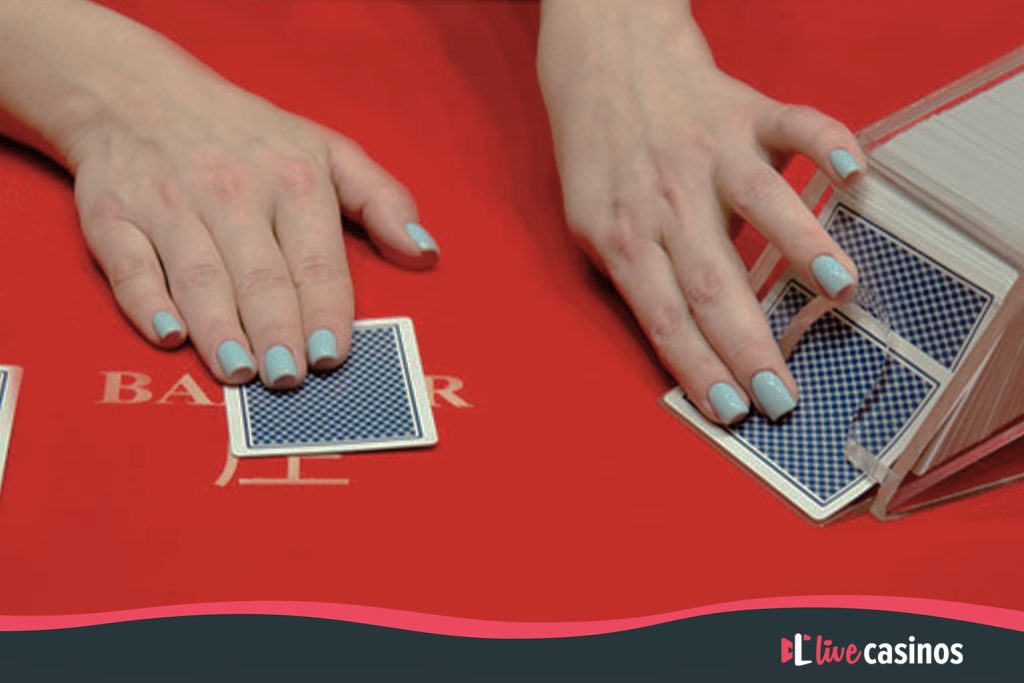
A crooked dealer can create that advantage through a false shuffle. The dealer appears to mix the cards while secretly preserving a known block, or slug, of cards. Accomplices record the sequence and bet when that slug reaches the shoe.
A related method is the cutter scam. Hidden cameras capture the faces of cards while a player handles or fans the deck during the cut. Accomplices outside the casino reconstruct the sequence and relay betting instructions back to the table.
For an uninformed player, the key distinction is between an objectively predetermined result and a subjectively unknown one. If accomplices know the outcome but you do not know which side they are backing, your information has not improved or worsened. Your bet is still made without an edge, even though someone else at the table has one.
This may seem counterintuitive, but it is entirely true.
Casinos have responded with stricter shuffle supervision, tighter control over unshuffled cards, limits on how players may cut the deck, automated shufflers, smart shoes, dealer rotation, and closer surveillance of high-limit play. These controls make sequence-based scams far harder to carry out.



 The false shuffle scam, United States and Canada, 1975 to 2007

 So, is baccarat rigged?
 Facebook
 Pinterest
 Twitter
 LinkedIn
 Copy Link