





















 Roulette
 Blackjack
 Baccarat
 Poker
Poker
 Sic Bo
 Dragon Tiger
 Game Shows
  Top 5 Games
  See more
  Roulette Casinos
  Low Limit
  High Limit / VIP
  Exclusive
  How to Play
  Basic Strategy
  Top Tips
  FAQ
FAQ  Blackjack Casinos
  Baccarat Casinos
  Bonuses
  Poker Casinos
  Game Providers
  Sic Bo Casinos
  Dragon Tiger Casinos
  Credit and Debit Card
  e-Wallet
  Cryptocurrency
  Bank and Checks
  Pay by Phone and SMS
  See more
  How-To Guides
  Top Lists
  In-Depth
  Strategy
  Casino & Games
  Insight
  News
News  Promotions
 Guide to Live Casinos
  Top 10 Live Casino Tips
  Studio Locations
  FAQ & Help
  Meet The Dealers
  Our Awards
  How We Rate
  Responsible Gambling


 ENG
ENG 


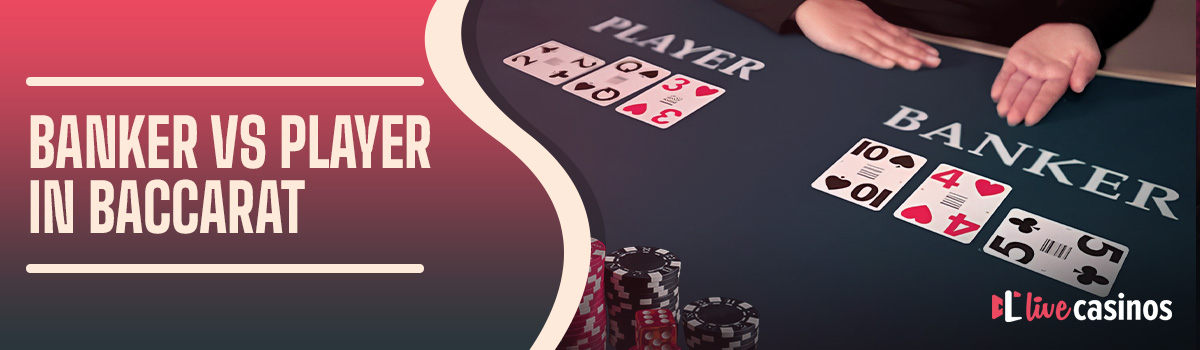
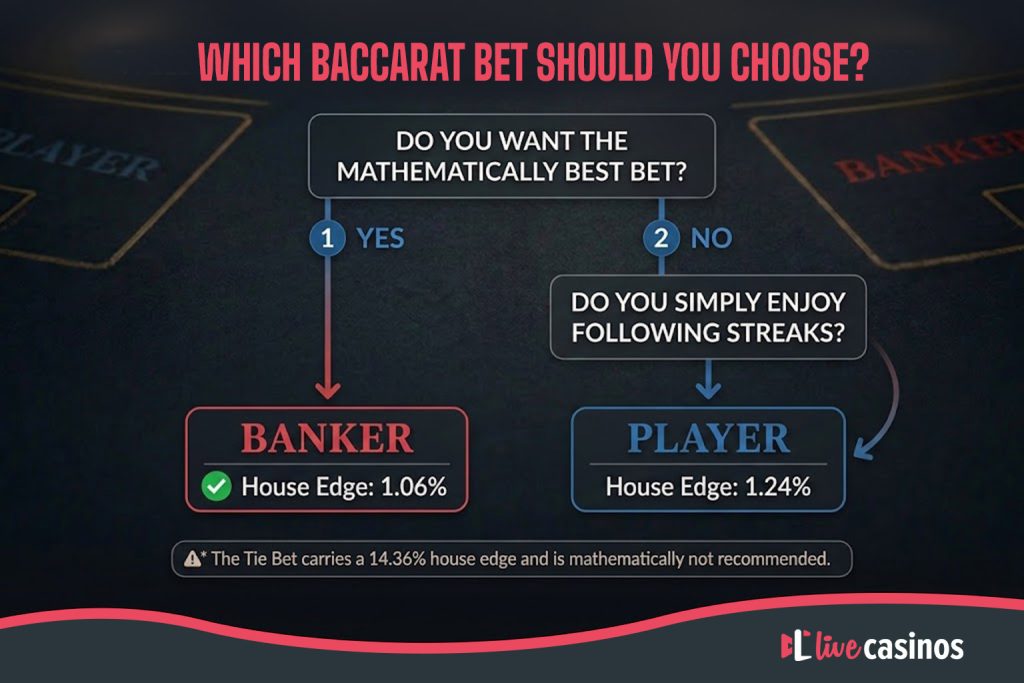
In baccarat, the Banker bet wins more often than the Player bet and carries a lower house edge after commission, yet most players consistently bet Player.
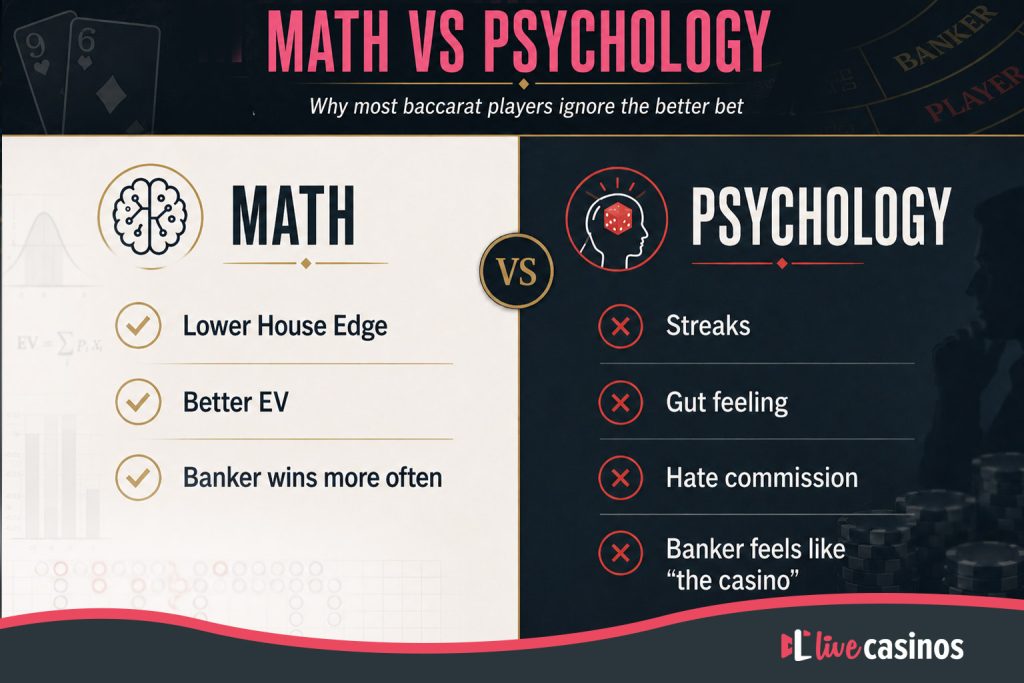
Baccarat is probably the only casino game in which one of two main opposing bets offers better winning odds than the other, yet most players ignore that advantage when choosing where to place their money. Instead, they prefer to bet following other inherent realities in casino games: streaks, chops, superstitions, hunches, etc.
Instead, they follow other familiar elements of casino play: streaks, chops, superstitions, hunches, and whatever else seems meaningful in the moment.
There is no close comparison in roulette or craps. In roulette, opposing even-money bets carry the same house edge, so choosing one side over another does not alter the underlying disadvantage. In craps, the Don’t Pass bet carries a slightly lower house edge than the Pass Line bet, yet only a small minority of players choose it. The reason is largely social. Don’t Pass is regarded as the “dark side” bet because the player appears to be siding with the casino against everyone hoping for the shooter to win.
The reluctance to bet Banker in baccarat is more intricate.
Baccarat players repeatedly place their money on the side with the higher house edge, even though doing so should cost them more over a long period of play. The reasons behind that choice reveal how easily perception, language, table culture, and short-term experience can outweigh a small but genuine mathematical difference.
Why the Banker bet wins more often than the Player bet
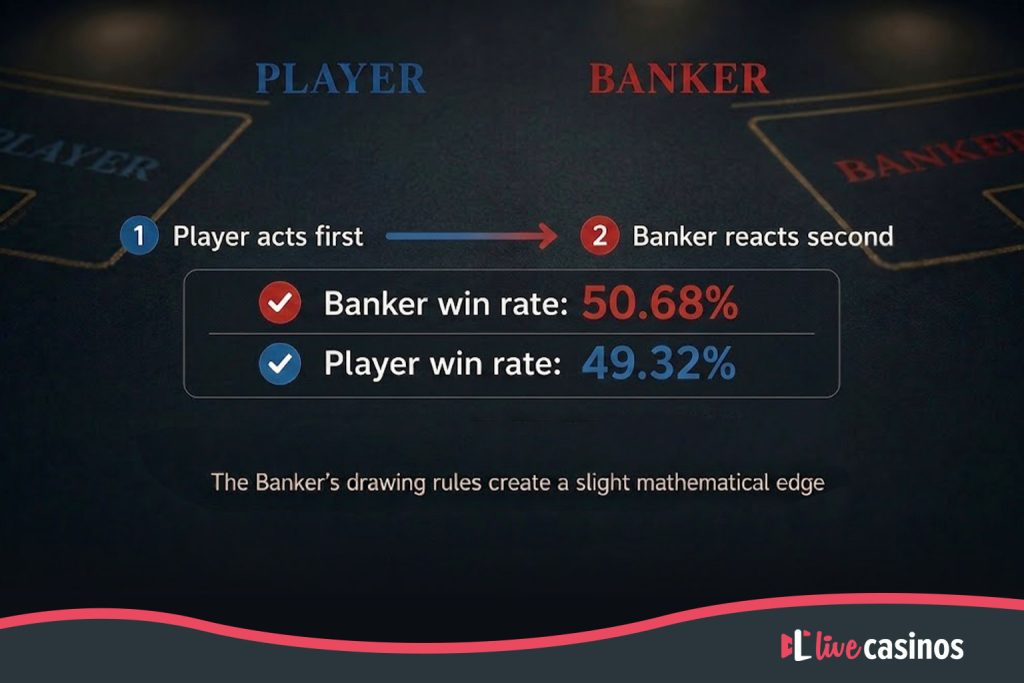
The Banker bet wins more often than the Player bet because of baccarat’s third-card drawing rule. The Player hand is always completed first according to a fixed schedule. The Banker hand is completed second, and whether Banker draws depends partly on the third card already dealt to Player. That information advantage gives Banker a slightly higher probability of finishing closer to nine: around 50.68% of decided hands, compared with 49.32% for Player.
The reasoning is somewhat similar to blackjack. In blackjack, players must complete their decisions before the dealer acts. A player can therefore bust and lose before the dealer faces the same risk.
In baccarat, the initial deal gives both Player and Banker two cards. When a third card is required, the Player hand is resolved first. Banker then follows a strict drawing table that may take the value of Player’s third card into account.
Banker does not have an advantage merely because it acts last. The advantage comes from the conditioned third-card rule. Banker’s action can change according to information that becomes available after Player has drawn.
That predetermined sequence gives the Banker hand a 50.68% chance of finishing closer to nine when ties are removed, against 49.32% for Player.
Consider a situation in which Player draws a high third card, from nine through king. A nine may reduce the value of the Player hand, except when the original two-card total was zero. Tens and face cards count as zero and provide no improvement at all. Banker can stand on certain totals that would have required a draw had Player received a more useful mid-value card.
This conditioned response is the source of Banker’s advantage.
From an expected-value perspective, Banker still produces a negative return over time because the casino applies commission. It simply loses less, on average, than Player when the same amount is wagered repeatedly.
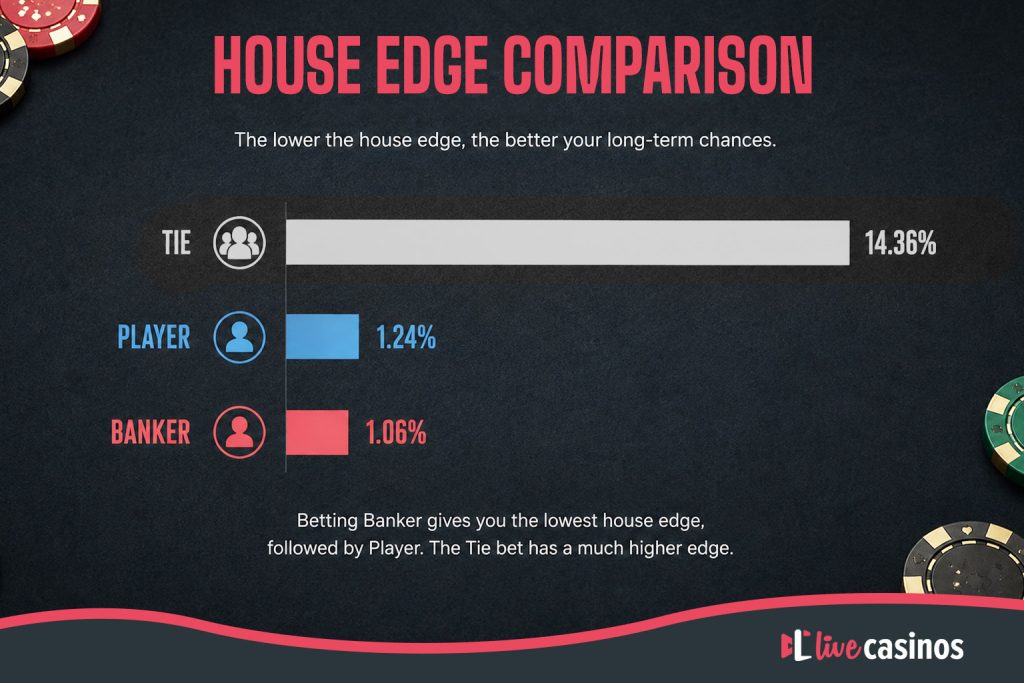
Tie hands occur on roughly 9.5% of rounds. When ties are included, Banker wins around 45.86% of all hands and Player wins around 44.62%. Those figures do not weaken the Banker advantage because Tie outcomes return the original Banker and Player wagers. Our baccarat calculator will help you if this sounds too complicated.
House Edge Reference Table
| Bet | House edge | Win frequency (of decided hands) | Payout |
|---|---|---|---|
| Banker | 1.06% | 50.68% | 1:1 minus 5% commission (effective 0.95:1) |
| Player | 1.24% | 49.32% | 1:1 |
| Tie | 14.36% | 9.52% of all hands | 8:1 (sometimes 9:1) |
Why is there a 5% commission on Banker Bets?
There is a 5% commission on winning Banker bets because Banker would otherwise carry a positive expected value for the player. Banker wins more than half of decided hands, so paying every win at even money would shift the long-run advantage away from the casino. The commission prices Banker’s structural advantage back into the wager, leaving a house edge of approximately 1.06%. It is the cost of betting on the side that wins more often.
Put simply, Banker wins more than 50% of hands once ties are excluded. If every winning Banker bet paid even money, a player who wagered the same amount on Banker every hand would have a mathematical advantage.
The percentage would be small, and short-term losses would remain entirely possible. A player with sufficient capital could still earn a long-run profit before casinos adjusted the payout structure.
Casinos prevent that by taking a 5% commission from winning Banker bets. That adjustment turns a player advantage of roughly 2% before commission into a casino advantage of around 1%. The resulting house edge is comparable to the edges faced by skilled players making low-edge wagers in blackjack or craps.
The 5% Commission – Mechanics, Psychology, and the No-Commission Variant
The standard commission lowers a winning Banker payout from even money to 0.95:1. A $100 winning bet therefore returns $95 in profit, plus the original $100 stake.
That adjustment resolves the casino’s mathematical problem. Without commission or another payout modification, Banker would have a positive expected value for the player. With the 5% deduction, the casino retains a house edge of approximately 1.06%.
Some players nevertheless interpret the commission as a penalty. I have seen players favor Player and openly explain that they would rather make the less informed bet than surrender part of a winning Banker payout. The word “commission” evokes taxes, fees, and deductions, which makes the wager feel less appealing even though its expected loss remains lower.
I have also watched players coordinate Banker wagers around perceived streaks in an attempt to “win back” commission paid during previous sessions. They mentally treat earlier commissions as a debt the table owes them.
These behavioral patterns are stronger in baccarat than in almost any other table game. Slot play may produce comparable rituals, but baccarat is where I have most often watched players move between streaks, chops, scoreboards, and sudden hunches during the same shoe.
How no-commission baccarat changes the wager
Some live dealer studios offer baccarat tables without the traditional 5% commission. Winning Banker bets usually pay 1:1, except when Banker wins with a total of six. In that case, the wager pays only 0.5:1.
Banker wins with six occur on roughly 5.4% of all hands, or about once every nineteen rounds. The half-pay rule raises Banker’s house edge from approximately 1.06% in standard commission baccarat to around 1.46% in the common no-commission version.
The preferred main wager therefore changes. At a typical no-commission table with the half-pay-on-six rule, Player carries a 1.24% house edge and becomes mathematically better than Banker.
A player who moves to no-commission baccarat to avoid the visible deduction may unknowingly accept a worse bet.
This is where psychology exerts its strongest influence. Players who dislike standard Banker commission frequently accept the no-commission structure without resistance, even though the embedded cost is higher.
The casino removes the moment when chips are taken from a winning payout. That reduced friction feels more favorable, although the underlying odds have deteriorated.
Variants such as EZ Baccarat apply the same broad principle through altered settlement rules and side bets. They speed up play, remove visible commission collection, and shift the casino advantage into the game structure.
The approach is an effective re-engineering of commission psychology. The deduction disappears from view, while its mathematical function remains.




 Is baccarat really a no-skill game?
 Facebook
 Pinterest
 Twitter
 LinkedIn
 Copy Link