Walk into any casino’s high-limit room and you’ll find baccarat tables dominating the floor. From the Macau VIP salons generating billions in annual revenue to the private rooms at Bellagio and Wynn, baccarat reigns as the preferred game of the world’s wealthiest gamblers.
This dominance isn’t accidental—several factors combine to make baccarat uniquely suited for high-stakes play.
Baccarat’s first appeal is simplicity. Unlike blackjack, which requires memorizing complex basic strategy charts, or poker, which demands reading opponents and calculating pot odds, baccarat offers a simple decision: Player or Banker. No splitting pairs, no doubling down decisions, no complicated betting patterns to master. Just pure, uncomplicated wagering.
The house edge ranks among the casino’s lowest. Banker bets carry a 1.06% house edge, Player bets 1.24%—significantly better than American roulette (5.26%), most slot machines (4-15%), or nearly any other game where players face the house rather than each other. Only perfect blackjack play yields a lower edge, and that requires mastering strategy. In baccarat, optimal play is simply “bet Banker.” You can’t mess it up.
On top of all that, baccarat table limits are open to serious money. While standard casino tables might cap bets at $5,000-$10,000, high-limit baccarat tables routinely accept $100,000 per hand, with private arrangements pushing far higher.
On a less practical note, baccarat enjoys an air of sophistication and exclusivity, reinforced by James Bond’s preference for the game and its prominence in Asian high-roller culture. The formal atmosphere of baccarat rooms, the elaborate dealing rituals, the scoreboards tracking results—all contribute to a sense that this is gambling for the elite. For many wealthy players, this prestige matters as much as the mathematical advantages.
The Mathematics of High-Stakes Baccarat
Understanding how the house edge scales is crucial for high-stakes players. That 1.06% on Banker bets sounds negligible – it’s barely more than 1%, after all. However, the absolute cost qucikly grows as you increase your betting size.
Consider the impact over different betting levels:
- At $1,000 per hand over 1,000 hands: $1 million wagered × 1.06% = $10,600 expected loss. Most dedicated and wealthy players would find this an acceptable entertainment cost for several months of play, but not a single session.
- At $10,000 per hand over 1,000 hands: $10 million wagered × 1.06% = $106,000 expected loss. Now we’re talking serious money, even for wealthy individuals – more than many people earn annually.
- At $50,000 per hand over 1,000 hands: $50 million wagered × 1.06% = $530,000 expected loss. Half a million dollars in entertainment costs over perhaps 15-20 hours of play. This level requires substantial wealth to sustain.
Many players fixate on the fact that Banker wins approximately 51% of hands (excluding ties). “I win half the time,” they reason. But the 5% commission on Banker wins means that even winning slightly more than you lose still leaves you behind mathematically. The house edge calculation already factors in this winning percentage and the commission—the 1.06% figure represents your expected loss per dollar wagered over time, commission included.
Baccarat Strategy for High Stakes
Optimal baccarat strategy requires three sentences:
- Always bet Banker.
- Never bet Tie.
- Manage your bankroll properly.
Everything else is noise—betting systems that don’t work, pattern recognition that reveals nothing, superstitions that have no basis in maths=s. High-stakes players who want to minimize losses need to understand these three principles.
The Core Strategy: Always Bet Banker
The maths are pretty clear: Banker is the single best bet in baccarat, side bets included. Here’s why.
Banker wins 45.86% of all hands dealt. Player wins 44.62% of all hands dealt. Ties occur 9.52% of the time and return both bets.
When we exclude ties from the equation (since they’re pushes), Banker wins roughly 50.68% of resolved hands while Player wins 49.32%. This might seem like a tiny difference, but it’s substantial over thousands of hands.
The 5% commission on Banker wins exists precisely because Banker has this advantage. Without the commission, Banker bets would actually have a negative house edge—meaning players would have an advantage over the casino. The commission restores the house edge to 1.06%, still leaving Banker as the optimal choice.
Compare the house edges directly: Banker at 1.06% versus Player at 1.24% creates a 0.18 percentage point difference. Over 10,000 hands at $10,000 per hand:
- Betting Banker: $100 million wagered × 1.06% = $1,060,000 expected loss
- Betting Player: $100 million wagered × 1.24% = $1,240,000 expected loss
That’s a $180,000 difference. Even for high-rollers, $180,000 matters. You’re literally paying $180,000 extra over that volume for the privilege of betting Player instead of Banker. Unless you have a specific reason (we’ll discuss card counting shortly), there’s no justification for accepting this additional cost.
Why Banker Has the Advantage
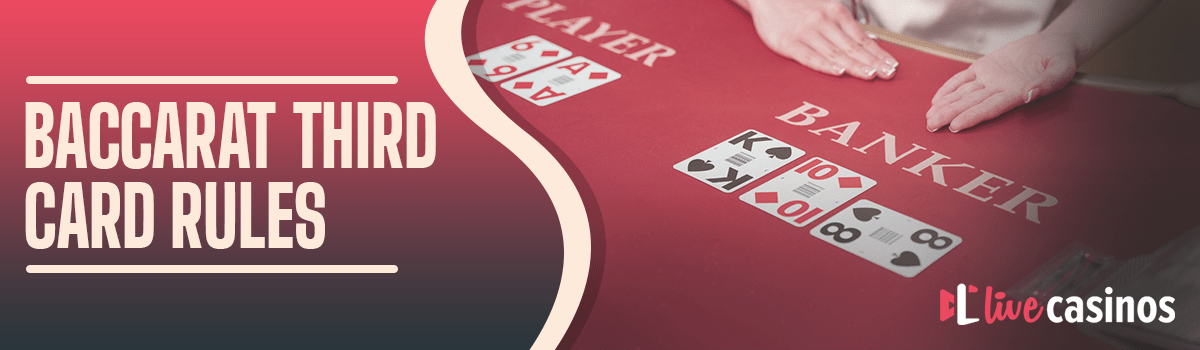
The third-card drawing rules create the Banker bet’s advantage.
Player acts first, always drawing according to a simple rule: draw on 0-5, stand on 6-7. Natural 8 or 9 ends the hand immediately. This rule is straightforward and consistent.
Banker acts second, and the third card drawing rules depend on both Banker’s own total and Player’s third card (if drawn). This conditionality gives the Banker an informational advantage.
This responsiveness of Banker’s drawing strategy that adapts based on the Player’s third card creates a small but consistent edge. Banker draws aggressively when it helps and stays put when it doesn’t. The Player has no such luxury and must follow rigid rules regardless of what might help.
Let’s be direct: the Player bet is never mathematically superior to the Banker. The 1.24% house edge on Player bets is higher than the Banker’s 1.06%. If your goal is minimizing expected losses (which should be every rational gambler’s goal), you should bet on the Banker exclusively.
Card counting can occasionally indicate that the Player is favorable. We’ll discuss this in detail later, but advanced players using running count techniques can identify situations where the remaining shoe composition favors Player over Banker. However, these situations are rare (perhaps 5-10% of shoes) and the edge gained is minimal (typically under 0.05%).
The Tie Bet: Never, Under Any Circumstances
Tie bets are financial suicide at high stakes. The numbers are brutal: Tie bets pay 8:1 or 9:1, depending on the casino, but the actual probability of a tie is approximately 9.52%. Let’s calculate the house edge:
- At 8:1 payout: (0.0952 × 8) – 0.9048 = -0.1436, or a 14.36% house edge
- At 9:1 payout: (0.0952 × 9) – 0.9048 = -0.0485, or a 4.85% house edge
Even the more generous 9:1 payout carries a house edge more than four times worse than Banker bets. The 8:1 payout, which is by far the most common, is absolutely catastrophic at over 14% house edge. This ranks among the worst bets in the entire casino.
Side Bets
Most baccarat tables offer side bets that allow players to wager on various additional aspects of the round.
There are quite a few baccarat side bets out there, varying in their odds, excitement, design, and profitability. However, they consistently have a much higher house edge than either the Banker or Player bets.
You can find a full breakdown of almost every common side wager in our guide to baccarat side bets. The breakdown includes standard payouts, probabilities, and house edge rates for almost every wagering option that exists.
The main takeaway is this: all baccarat side bets have a higher house edge than the main Player and Banker wagers, which makes them statistically sub-optimal. Some have decent rates, such as a Dragon Bonus Player, but none are actually good enough to ever outshine Banker (or the Player, for that matter).
Standard vs. No Commission Baccarat
Standard baccarat charges a 5% commission on Banker wins, yielding a 1.06% house edge. This is the most common format and offers the best odds for players.
No Commission baccarat sounds appealing: no commission deducted from Banker wins. However, the catch is that Banker hands that win with a total of 6 pay only 0.5:1 (half your bet) instead of the standard 1:1. This single rule change increases the house edge to approximately 1.46% on Banker bets.
As a rule, you should always choose standard commission baccarat over no-commission variants. The 5% commission is transparent and results in better overall odds than the hidden cost of reduced payouts on Banker 6 wins.
Bankroll Management for High-Stakes Baccarat
Baccarat requires 100-150 betting units for an adequate session bankroll. This isn’t just caution – it’s a realistic assessment based on the game’s variance and the Kelly Criterion.
For example, a player betting $5,000 per hand needs $500,000-$750,000 for a proper session bankroll. At $10,000 per hand, that’s $1 million to $1.5 million. These numbers sound enormous, but they provide the cushion necessary to weather the inevitable losing streaks that occur in baccarat.
An alternative approach to unit-based calculations: bet 1-2% of your session bankroll per hand.
Also, make sure to set predetermined limits before every session and honor them without exception:
- Loss limit: Stop when you’ve lost 40-50% of your session bankroll. With a $500,000 session stake, your loss limit is $200,000-$250,000. When you hit this threshold, leave immediately. The session is over.
- Win goal: Target 25-40% profit on your session bankroll before stopping. With a $500,000 session stake, quit when you’re up $150,000-$200,000. This might seem conservative when you’re winning, but it protects profits from inevitable regression to the mean.
Check out our guide to high-stakes bankroll management for more advice (and detailed explanations on why bankroll management is crucial.)
Expected Loss Calculations
Understanding your expected losses helps set realistic expectations and budgets:
Formula: (Total amount wagered) × (House edge) = Expected loss
- Example 1: Bet $10,000/hand for 100 hands = $1 million wagered × 1.06% = $10,600 expected loss
- Example 2: Bet $25,000/hand for 200 hands = $5 million wagered × 1.06% = $53,000 expected loss
- Example 3: Bet $50,000/hand for 500 hands = $25 million wagered × 1.06% = $265,000 expected loss
These are expectations, not guarantees. Variance means your actual results will differ significantly in any given session.
Card Counting in Baccarat
Card counting in baccarat is possible but far less rewarding than in blackjack.
The maximum achievable edge is tiny, favorable situations are rare, and the mental effort required is substantial.
Most high-stakes recreational players won’t find counting worthwhile, but understanding the technique helps you evaluate whether it’s worth pursuing.
The basic principle is quite simple: excess high cards (7, 8, 9, 10, J, Q, K, A) favor the Player because they reduce the frequency of third-card draws, which benefits the Banker more than Player. Excess low cards (1, 2, 3, 4, 5, 6) favor Banker because third-card draws become more common and Banker’s conditional drawing rules exploit this.
A simplified counting system tracks this imbalance. When the count indicates excess high cards remain, you bet Player. When the count indicates excess low cards, you bet Banker. The default is always Banker unless the count becomes extreme enough to justify switching.
The Reality of Baccarat Card Counting
The maximum achievable edge is approximately 0.05% in the most favorable counts. Over $10 million wagered, a 0.05% edge yields $5,000 in theoretical advantage—assuming you identify and capitalize on every favorable situation perfectly, which is a lot to ask.
Favorable counts occur infrequently. Perhaps 5-10% of shoes reach counts extreme enough to justify switching to Player. The other 90-95% of the time, you’re betting Banker at a 1.06% disadvantage. Your overall edge across all shoes remains negative, even with perfect counting.
Last but not least, the required effort is substantial, especially with so little payoff. Tracking every card through an 8-deck shoe demands intense concentration. At high stakes, you’re also managing large bets, interacting with dealers and hosts, and are generally distracted by the buzz of an active casino floor.
As a result, trying to count cards in baccarat is rarely worth it. If you’re playing hundreds of hours monthly and want to minimize long-term costs, counting makes more sense. Over 1,000+ hours annually, that 0.5% edge on 10% of hands adds up. But this describes professional play, not recreational high-roller gambling.


























 Roulette
 Blackjack
 Baccarat
 Poker
Poker
 Sic Bo
 Dragon Tiger
 Game Shows
  Top 5 Games
  See more
  Roulette Casinos
  Low Limit
  High Limit / VIP
  Exclusive
  How to Play
  Basic Strategy
  Top Tips
  FAQ
FAQ  Blackjack Casinos
  Baccarat Casinos
  Bonuses
  Poker Casinos
  Game Providers
  Sic Bo Casinos
  Dragon Tiger Casinos
  Credit and Debit Card
  e-Wallet
  Cryptocurrency
  Bank and Checks
  Pay by Phone and SMS
  See more
  How-To Guides
  Top Lists
  In-Depth
  Strategy
  Casino & Games
  Insight
  News
News  Promotions
 Guide to Live Casinos
  Top 10 Live Casino Tips
  Studio Locations
  FAQ & Help
  Meet The Dealers
  Our Awards
  How We Rate
  Responsible Gambling


 ENG
ENG 







 Variety & Variance
 Facebook
 Pinterest
 Twitter
 LinkedIn
 Copy Link