Walk into any casino’s high-limit room, and you’ll notice blackjack tables occupy prime real estate, right alongside baccarat.
This isn’t accidental. Blackjack attracts a specific type of high-roller: analytical players who appreciate that their decisions directly affect outcomes, who understand probability well enough to master basic strategy, and who recognize that the 0.5-0.7% house edge beats nearly everything else the casino offers.
The numbers tell the story: a perfect basic strategy in a favorable blackjack game yields a 0.5-0.7% house edge. Compare this to baccarat’s 1.06% on Banker bets, European roulette’s 2.70%, or craps’ 1.4% on Pass Line. Only poker (where you play against other players) and sports betting (for sharp bettors) offer potentially better odds.
Long story short, blackjack offers the single best odds among house-banked games where you’re wagering directly against the casino.
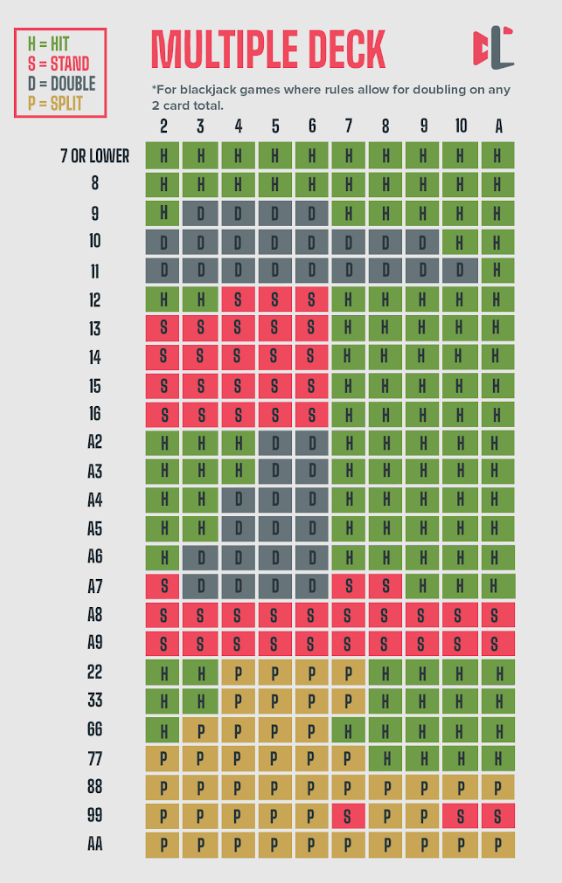
More significantly, player decisions matter. Hit, stand, double down, split, surrender – these aren’t just betting options that control risk and reward, like they are in roulette and other games. They are strategic decisions that directly affect your expected value. Make the right call, and you minimize losses or maximize gains. Make the wrong call, and you’re donating money to the casino.
Then there’s advantage play. Card counting—tracking the ratio of high to low cards remaining in the shoe—can create a genuine 1-2% player edge over the casino. This is extraordinary. Almost nowhere else in gambling can skilled players gain a mathematical advantage over the house. While casinos have countermeasures and monitor for counters, the possibility exists for those willing to invest the effort.
The Challenge at High Stakes
Now that we understand the appeal, it’s time to look at some of the challenges facing high-stakes blackjack players:
- Perfect execution becomes more important due to its higher impact. That basic strategy chart you memorized? At $5,000 per hand, one mistake per hundred hands costs you $250-500 in expected value over time. Over a year of regular play, let’s say 10,000 hands, poor strategy costs you $25,000-50,000 beyond the unavoidable house edge. These aren’t hypothetical losses; they’re real money left on the table through preventable errors.
- Variance at high stakes is psychologically brutal. Even with perfect play, losing streaks of 10-15 hands occur regularly. At $5,000 per hand, that’s $50,000-75,000 gone in perhaps 20 minutes. Even if you’re aware that this is statistically unavoidable, it still feels crushing. Bad streaks feel worse in blackjack than baccarat because you made decisions that seemingly lead to those poor results; doubling down on 11 and losing to a dealer 21 feels more frustrating than simply losing a baccarat hand.
- Finding good games becomes challenging. Many live casino high-limit tables now offer inferior rule sets compared to main floor tables because casinos (correctly) assume some high-rollers prioritize the VIP room experience over optimal play. You need to explicitly verify rules before playing, even in premium environments.
- Rule variations matter a lot more for large wagers. For example, A 0.2% difference in house edge – the gap between dealer standing versus hitting soft 17—costs $20,000 over $10 million wagered.
- Casino scrutiny intensifies at high stakes. If you’re counting cards, surveillance watches closely. If advantage play is detected or even suspected, casinos implement countermeasures ranging from preferential shuffling to outright exclusion.
Rule Variations in Blackjack: What Matters at High Stakes Tables
Understanding which rules matter is fundamental to successful high-stakes play. You need to be on the lookout for player-friendly rules and avoid bad ones as much as possible.
The table below showcases the impact of common blackjack rule variations on the game’s house edge. We’ll then go through the most common and impactful of these variations and illustrate how important they can be.
Blackjack Payouts
ALWAYS play on 3:2 tables, never 6:5. Never compromise on this rule. Tables with 6:5 payouts have a 1.4% higher house edge than those with 3:2. which makes them almost four times worse for your expected return. You can find out more about this variation in this breakdown.
At high stakes: 6:5 costs $140,000 over $10 million wagered compared to 3:2. If you’re playing $5,000 per hand for 2,000 hands annually, that’s exactly $10 million wagered. The 6:5 rule costs you $140,000 extra per year.
ALWAYS play on tables where the dealer hits on a soft 17. This reduces the main hand house edge by around 0.2%. depending on other rules.
That 0.2% difference equals $20,000 over $10 million wagered. For our $5,000 per hand player betting 2,000 hands annually, H17 costs an extra $20,000 per year compared to S17.
Always seek out S17 tables. Many high-limit rooms offer both—ask explicitly which tables use S17.
Priotitize tables that allow Early Surrender, then those that allow Late Surrender. Early surrender can decrease a game’s house edge by a whopping 0.39%, while Late Surrender is less impactful, with a 0.07% decrease in house advantage.
Unfortunately, most tables these days don’t allow any sort of surrendering – especially in the world of live dealer online blackjack. However, you should still choose tables that allow it, where available.
The impact of surrendering is a bit harder to calculate because its availability also impacts basic strategy. However, using Surrender as part of a basic strategy can demonstrably decrease the house edge, so it’s a good rule to have altogether.
Complete Rule Combinations: The Big Picture
For better or worse, these rule variations all “stack” and impact the game’s EV in various ways. In other words, every blackjack table offers a combination of rules that ultimately determine its house edge.
We’ll illustrate how that works by considering several theoretical tables and their main differences and figures:
- Best possible: Single deck, 3:2 blackjack payouts, Dealer Hits on Soft 17, doubling after splitting allowed, late+early surrender available, resplitting aces allowed. That table would offer a theoretical house edge of just 0.15%. These days, it would be virtually impossible to find an active table with rules like these.
- Typical good game: 6 decks, 3:2 blackjack payouts, Dealer Hits on Soft 17, doubling after splitting allowed, late surrender available. With these rules, a table would produce around 0.35% – 0.40% house edge. This is realistically the best you’ll find at high stakes, so you should try to find something in its ballpark.
- Acceptable game: 6-8 decks, 3:2 blackjack payouts, Dealer Hits on Soft 17, doubling after splitting allowed, no surrender available. The house edge sits around 0.50%-0.55%, depending on the number of decks in use. The vast majority of live casino blackjack tables follow similar rules, which means this is the best you’ll get in many situations.
- Mediocre game: 6-8 decks, 3:2 blackjack payouts, Dealer Hits on Hard 17, doubling after splitting not allowed, no surrender available. These rules imply a roughly ~0.72% house edge. Such tables are best avoided, but you can play them if absolutely necessary or if the comps/convenience justify the extra cost.
- Terrible game: 6-8 decks, 6:5 blackjack payouts, Dealer Hits on Hard 17, no surrender. This horrendous collection of predatory rules implies a house edge of more than 1.8%. Never play. Walk away immediately. This is worse than baccarat and barely better than roulette. You’re being exploited.
Bankroll Management for High-Stakes Blackjack
At high stakes, bankroll management is the single factor that determines whether a skilled blackjack player survives long enough for strategy and edge to matter at all.
Blackjack’s relatively low house edge often gives players a false sense of security. Even at 0.5%–0.7%, variance remains unforgiving. Large bets compress time. A losing streak that would feel manageable at $100 per hand becomes psychologically and financially destabilizing at $5,000 or $10,000 per hand.
A commonly accepted guideline for high-stakes blackjack is a minimum session bankroll of 50 to 100 betting units. This range allows a player to withstand normal negative variance without being forced into poor decisions or premature exits.
Concrete examples illustrate the scale involved:
-
At $1,000 per hand, a realistic session bankroll starts at $50,000–$100,000
-
At $5,000 per hand, a session bankroll of $250,000–$500,000 is expected
-
At $10,000 per hand, anything below $500,000 exposes the player to rapid elimination during normal downswings
These figures are not conservative exaggerations. Blackjack routinely produces losing streaks of 10–20 hands even with perfect play. At $5,000 per hand, a 15-hand losing streak represents a $75,000 drawdown without a single mistake being made.
Equally important is bet sizing discipline within a session. High-stakes players should avoid increasing bets emotionally to recover losses. Progressive betting systems do not change expected value and become especially dangerous at high limits, where table maximums can cap recovery while losses remain uncapped.
Stop-loss limits should be defined before play begins. A common professional approach is to walk away after losing 20%–30% of the session bankroll. This protects against tilt-driven escalation and preserves capital for future sessions where conditions may be more favorable.


























 Roulette
 Blackjack
 Baccarat
 Poker
Poker
 Sic Bo
 Dragon Tiger
 Game Shows
  Top 5 Games
  See more
  Roulette Casinos
  Low Limit
  High Limit / VIP
  Exclusive
  How to Play
  Basic Strategy
  Top Tips
  FAQ
FAQ  Blackjack Casinos
  Baccarat Casinos
  Bonuses
  Poker Casinos
  Game Providers
  Sic Bo Casinos
  Dragon Tiger Casinos
  Credit and Debit Card
  e-Wallet
  Cryptocurrency
  Bank and Checks
  Pay by Phone and SMS
  See more
  How-To Guides
  Top Lists
  In-Depth
  Strategy
  Casino & Games
  Insight
  News
News  Promotions
 Guide to Live Casinos
  Top 10 Live Casino Tips
  Studio Locations
  FAQ & Help
  Meet The Dealers
  Our Awards
  How We Rate
  Responsible Gambling


 ENG
ENG 






 Is frequency of play important for bankroll management?
 Facebook
 Pinterest
 Twitter
 LinkedIn
 Copy Link