The key to reading a baccarat board quickly and easily is to avoid confusion and overthinking. If you manage both those things, you will have an easy time of it since the board is constructed to be a visual aid, not a mental one. Remembering the simplicity of the board, that the bead plate is a chronological log; the big road is the same data reorganized by streaks; and the three derived roads compare the big road’s columns against each other, goes a long way to make this doable within a few blinks of an eye.
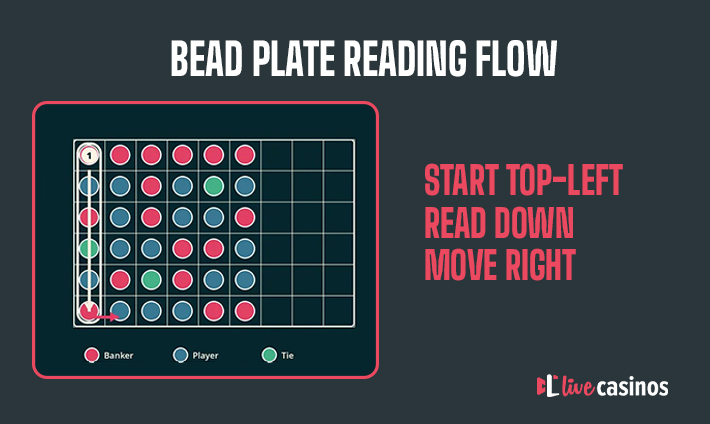
So, follow this pattern and you’ll be in like Flint:
- Start at the top-left corner
- Drop your eyes downward to the bottom of the column
- Move them to the next column on the right.
- Train your mind to memorize the red, blue and green color dots that represent Banker, Player and Tie respectively
- Quickly spot the ping-pong appearance of those dots representing the chops and streaks which is what baccarat betting is all about.
The Bead Plate and the Big Road: The Two Boards That Actually Matter
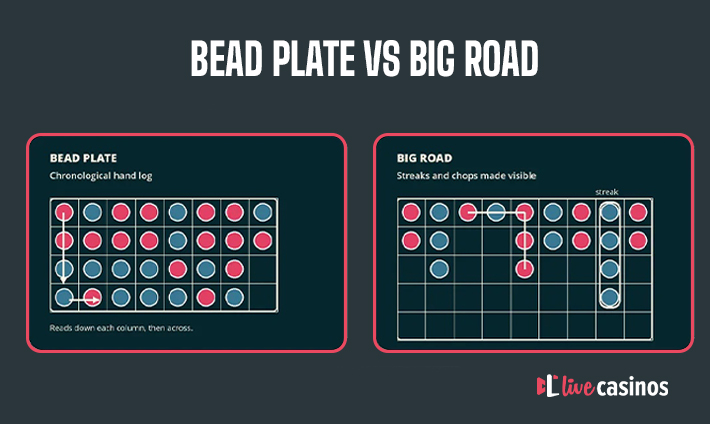
The bead plate, being the grid that records each baccarat hand, is the most direct and unfiltered record of the shoe’s sequence. It’s a simple chronological log that tracks every single hand outcome in the exact order as it comes out of the shoe. Many bead plates now give the exact score of each hand (or at least the winning total), which serves some players psychologically as if the winning side is like a football team winning by more than one goal. This facet can make the bettor actually believe that that previous winner is a stronger favorite to win again as it just “crushed” the losing hand. Other players who fancy playing baccarat side bets based on the winning margin of the hands are also attracted to this feature.
The bead plate also offers players an almost juvenile understanding of the shoe since it provides the hand data without the sophistication one might find on a graph. It’s an easy intake of information relevant to players’ betting strategies and presents absolutely no complexities. This is especially important for beginners at the table looking to see how many hands each side has won at any point in the shoe.
As the big road reorganizes that same data so that streaks and chops are easily visible at a glance, high rollers will be drawn to that segment the same way smaller bettors are drawn to the bead plate. I’ve both seen this reality from the outside and lived it from within while sitting at the edge of a high-stakes baccarat game in full swing. My $500 and $1,000 chips would be swirling around inside my half-closed fist, waiting impatiently to be laid down onto a yet undecided betting circle while my eyes were being drawn to that big road. Then suddenly that half-closed fist would open, the purple and orange chips dropping onto the same betting circle as the previous hand as the winning streak took form.
This is what baccarat players are looking for. Following the big road on the same winning side of the curve gives a rhythmic feeling of euphoria when that big road keeps leading to the same betting circle hand after hand.
The Big Road grid runs six rows deep before a column folds sideways into what regulars call a Dragon Tail – the visual signature of a streak that has gone past six in a row. Following a Dragon Tail by betting into the streak has its own name on the casino floor: Follow the Dragon. It is exactly the behavior the boards encourage, and exactly the kind of pattern players read into long after the shoe has stopped offering anything to read.’ Editorial team to adjust phrasing to match Richard’s voice; the three named concepts (Dragon Tail, six-row column, Follow the Dragon) must all appear.
I have seen hundreds of high-stakes baccarat players jerking their heads back and forth from the scoreboard to their chips inside the betting circle, their fervor growing with each new hand that became part of the streak, feeling adrenaline rush through their veins as the colored dots of the big road genuinely assured them that some higher power was controlling their good fortune at the baccarat table.
The Three Derived Roads – Big Eye Boy, Small Road, Cockroach Pig
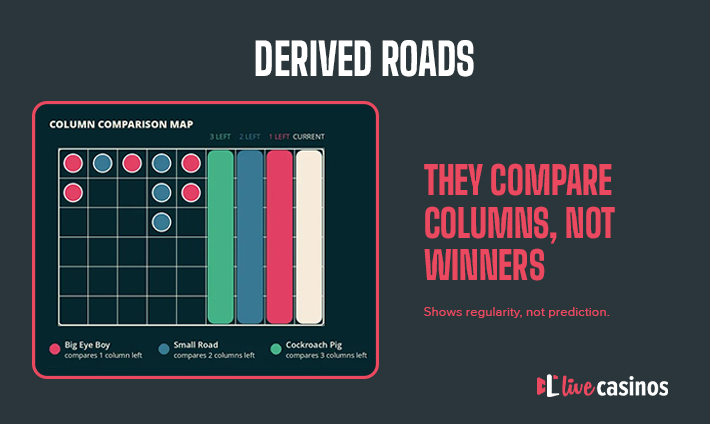
The difference with these three roads is that they do not track wins and losses directly. Instead, they track regularity and irregularity as it coincides with the big road. The big eye boy, small road and cockroach pig all act to show past histories when the last hand causes a new column in the big road, ignoring the new column and comparing the previous column to one of three columns farther to the left, which gives a multi-perspective hand-history going back.
Players need to understand that these roads are not laid out to predict the outcome of hands but rather to give the players more things to look at and more ways to feel that they’re correctly reading the shoe, more fodder to convince them they understood the mythical order of baccarat cards.
There seems to be both a psychological and common-sense drive behind these home-grown inventions rather than anything analytical. The first mental aspect is that concerning the behavior of the shoe, which can almost be humanized by the psychological effect. What that means is that players gauging these roads, looking to see if the shoe is behaving in a regular manner or irregular one, want to know if the shoe can react as it had been reacting. This particularly applies to streaks. A player gauging the big road and seeing that its last column has the same depth as the column before that, sees the road mark a red, meaning the shoe is behaving consistently or regularly, which inspires him to follow that shoe and believe in the streak. If the columns differ, the road marks a blue, meaning the pattern is breaking, spawning the interpretation that a new betting pattern has to be adopted, precisely one that calls to follow the chop.
The common-sense aspect is to do what it looks like. Players looking at the roads and seeing the map in a conclusive picture generally think, “Well, this is how it’s going; it only makes sense that it will continue this way, at least for the next hand. Of course, this is not common sensical at all, but it is the result of the psychological input the players themselves put in their minds.
First and foremost, know the importance of what the board does. That is, it helps you sort through all the mystery and intrigue that baccarat is. It puts out a real common-world description of what is going on in the game-the reality-and leaves the other dimensions such as imagination and wishful thinking up to the players. And it does this with a mastery of simplicity. It does a great job making you aware of the current state of the game, helps you remember the key factors that go into your betting scheme and makes you more comfortable as you develop a feel for the game.
In spite of these positives, remember at all times that the board does not have any effect on the true odds of the next or following hands as each hand is an independent occurrence. Only the initial four-card deal and the third-card draw determine which side is going to win or if there’s a tie.
The standard published probabilities – the same figures every reference work uses – are Banker 45.86%, Player 44.62%, and Tie 9.52%. The third-card draw decides the rest, which is roughly two-thirds of all hands.
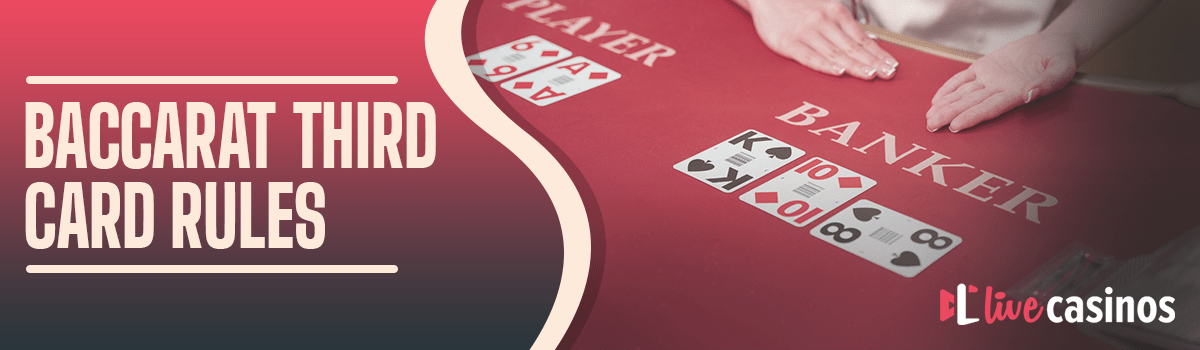
When no natural – a two-card total of 8 or 9 that ends the round immediately – and no 6-6, 7-7 or 7-6 hand-ending combination occurs, which is roughly two-thirds of the time, the player takes a third card based on predetermined rules just like the dealer does in blackjack. But the bank either takes a third card or stands based on what the value of the third card drawn by the player is. This rule will seem a bit complicated at first for beginners, but after a few play-sessions it gets easy to memorize.
To see the totality of what these boards do and don’t do, you can refer to the following chart:
| What the boards do well |
What the boards do not do |
| Records each hand coming out of the shoe. |
Predict the outcome of the next hand. |
| Facilitates quick viewing of streaks and chops. |
Reveal any ‘pattern’ the casino is hiding. |
| Lets players keep track without notetaking. |
Change the odds of the Banker, Player, or Tie bet. |
| Looks the same online as in a brick-and-mortar baccarat room. |
Give one player an edge over another. |
Why Players Read so much into the Boards
The main reason for this behavior is due to the psychological effect of baccarat outcomes coupled with human nature to think and overthink.
People playing baccarat often obsess with streak-and-chop outcomes, certainly more than in any other casino game. And doing this strains peoples’ brains. Watching a baccarat board can take you from certainty to doubt, back to certainty and doubt again. You ask yourself, “Should I stay with the streak? It may never end.” Or: “Should I bet the other side? It’s bound to change.”
I have done this countless times myself at the baccarat table. I can remember one time when I won six Player bets in a row, all with natural 8s and 9s. Then after going through the baccarat scoreboard back-and-forth, I, for some reason I’m still not sure about to this day, switched my bet to Banker. Then the Player won a seventh hand in a row with yet another natural. You can imagine the mental torture that went on inside my head going into the next hand. Should I go back to betting Player, thinking a huge double-digit-long streak is about to take place, or: Should I follow the shoe, convincing myself that the Player would win five or more hands in a row.
I ended up doing the only sane thing possible. I got up from the table and didn’t return until that shoe ended. I did not want to know what happened after that seventh consecutive Player winning hand.
How Live Dealer Baccarat Compares to the Physical Room
The boards on Evolution, Pragmatic, and Playtech live baccarat tables show the same five roads, in the same colors, with the same logic that has defined Asian baccarat rooms for fifty years.
What changes is the surface, not the substance.
The digital boards update automatically, animate as new hands come out, and render at a uniform brightness no overhead screen in a physical room can quite match. In some of the older Macau rooms I have spent time in, the boards are still hand-marked or projected from camera feeds onto overhead displays, and the angle from one seat to another determines what you can see. The digital boards on live dealer tables remove that variable – every player at the table sees the same clean rendering.
The third-card rule, the colors, the meaning of each grid – none of that changes between physical and live dealer baccarat. If anything, the digital boards are easier to read.
To conclude, they are virtually identical, but make sure you take the word “virtual” in the right context!
The only differences are how they meet the eye. Live Dealer Boards are digital, appear automatically (perhaps making you notice them more than at the brick & mortar table) and are usually animated. They may also be easier to read due to the flawless nature of how they appear on screen.
But the details, basic colors and meanings of each grid are the same. On the brick & mortar tables, players may also have initial problems grasping the connotations of the roads, along with some uncertainty how to fit them in with betting logic, but the viewing is certainly unhindered unless the player’s distance and angle create those kinds of problems. Obviously, the Live Dealer Boards have no such impediments.
So, as your experience playing both channels increases, the differences in the boards will become less and less noticeable.
Baccarat Board FAQs
How do you read the board in baccarat?
Reading a baccarat board starts with knowing what each section is trying to show you. The bead plate records the hands in simple chronological order, while the big road rearranges those same results into streaks and chops. Banker wins are usually shown in red, Player wins in blue and Ties in green.
Start from the top-left of the grid, read downward through the column and then move to the next column on the right. Once you get used to the colors and layout, the board becomes less of a puzzle and more of a quick visual history of the shoe.
Is there a trick to reading baccarat patterns?
The main trick is not to overthink them. Baccarat patterns can look convincing because the board is designed to make streaks, chops and repeats easy to see. But seeing a pattern is not the same as finding a prediction.
Each hand is still decided by the cards and the drawing rules, not by what happened in the previous hand. The board can help you understand how the shoe has played out so far, but it cannot tell you what the next result will be.
What is the difference between the bead plate and the big road?
The bead plate shows every hand in the order it was dealt. It is the most straightforward part of the baccarat board and is useful for seeing the full sequence of Banker, Player and Tie results.
The big road uses the same hand history but presents it differently. It creates new columns when the winning side changes, making streaks and chops much easier to spot. In simple terms, the bead plate tells you what happened hand by hand, while the big road shows how those hands formed trends.
What is the longest Banker streak ever recorded in baccarat?
There is no widely accepted official record for the longest Banker streak in baccarat. Players, dealers and online communities have reported very long Banker runs, including streaks in the teens, twenties and even higher, but these claims are usually anecdotal rather than officially verified.
The more important point is that even a long Banker streak does not make Banker guaranteed, or even “due,” on the next hand. Streaks are part of baccarat’s drama, not proof that the board has become predictable.
Do baccarat boards help you win?
Baccarat boards help you follow the action, but they do not give you a mathematical edge. They record previous results, make streaks easier to see and give players a cleaner way to track the shoe without writing anything down.
What they do not do is change the odds of Banker, Player or Tie. The next hand is still independent, no matter how dramatic the board looks.
What do the colors mean on a baccarat scoreboard?
Most baccarat scoreboards use red for Banker wins, blue for Player wins and green for Tie results. Some boards also add extra markings for naturals, pairs or hand totals, depending on the casino or live dealer studio.
The exact design may vary slightly, but the basic color language is usually the same across live dealer baccarat and physical casino tables.
What are the Big Eye Boy, Small Road and Cockroach Pig?
The Big Eye Boy, Small Road and Cockroach Pig are known as derived roads. Unlike the bead plate and big road, they do not simply record Banker and Player wins. Instead, they compare parts of the big road to show whether the shoe is behaving in a regular or irregular way.
Players use these roads to look for rhythm, consistency or disruption in the shoe. But like the rest of the board, they are still based on past results and do not predict future hands.
Why do baccarat players follow streaks?
Streaks are one of the biggest reasons baccarat boards are so popular. A run of Banker or Player wins can feel powerful, especially when the same color keeps dropping down the big road column hand after hand.
That feeling is exactly why players pay so much attention to the board. It gives the game momentum, suspense and a sense of direction. But emotionally convincing is not the same as statistically reliable.
Are live dealer baccarat boards different from casino baccarat boards?
Live dealer baccarat boards and physical casino boards show the same basic information. The main difference is presentation. Online boards are digital, automatic and often cleaner to read, while physical casino boards may depend on the table display, viewing angle or distance from the player.
In both versions, the bead plate, big road and derived roads serve the same purpose: they show what has already happened in the shoe.
Should beginners use the baccarat board?
Yes, beginners can use the baccarat board, but they should use it for orientation rather than prediction. The bead plate is especially helpful because it gives a simple view of how many Banker, Player and Tie results have appeared so far.
The best approach is to treat the board as a scorecard. It tells the story of the shoe, but it does not write the next chapter.


























 Roulette
 Blackjack
 Baccarat
 Poker
Poker
 Sic Bo
 Dragon Tiger
 Game Shows
  Top 5 Games
  See more
  Roulette Casinos
  Low Limit
  High Limit / VIP
  Exclusive
  How to Play
  Basic Strategy
  Top Tips
  FAQ
FAQ  Blackjack Casinos
  Baccarat Casinos
  Bonuses
  Poker Casinos
  Game Providers
  Sic Bo Casinos
  Dragon Tiger Casinos
  Credit and Debit Card
  e-Wallet
  Cryptocurrency
  Bank and Checks
  Pay by Phone and SMS
  See more
  How-To Guides
  Top Lists
  In-Depth
  Strategy
  Casino & Games
  Insight
  News
News  Promotions
 Guide to Live Casinos
  Top 10 Live Casino Tips
  Studio Locations
  FAQ & Help
  Meet The Dealers
  Our Awards
  How We Rate
  Responsible Gambling


 ENG
ENG 






 Paper Score Sheets
 Facebook
 Pinterest
 Twitter
 LinkedIn
 Copy Link