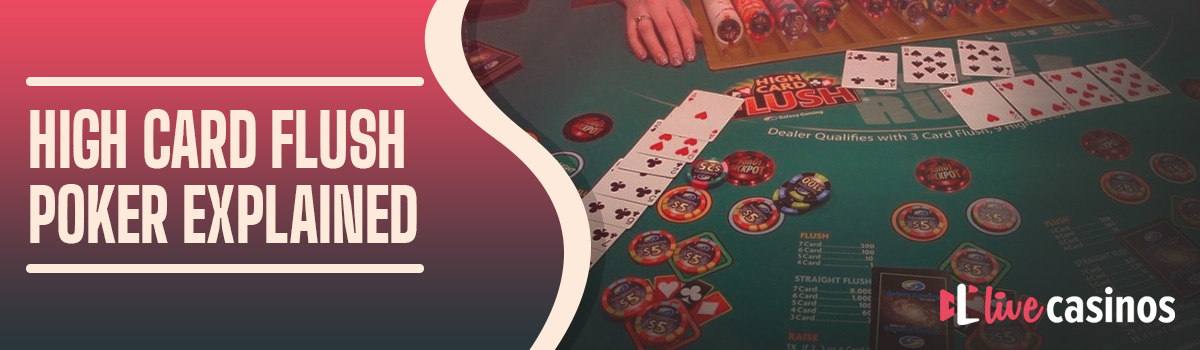
High Card Flush is a casino table game inspired by poker in which players compete against the dealer to make the longest flush (string of cards of the same suit) from a seven-card hand.
The game follows a structure similar to Caribbean Stud Poker or Three Card Poker: you draw a hand and have a single opportunity to change cards, raise, or fold. However, there’s a twist: instead of traditional poker hand rankings, the only thing that matters is the number of cards of a single suit that you’ve completed.
Think of it this way: it’s casino Stud Poker, but the goal is simply to get the strongest Flush possible, with no other hands available.
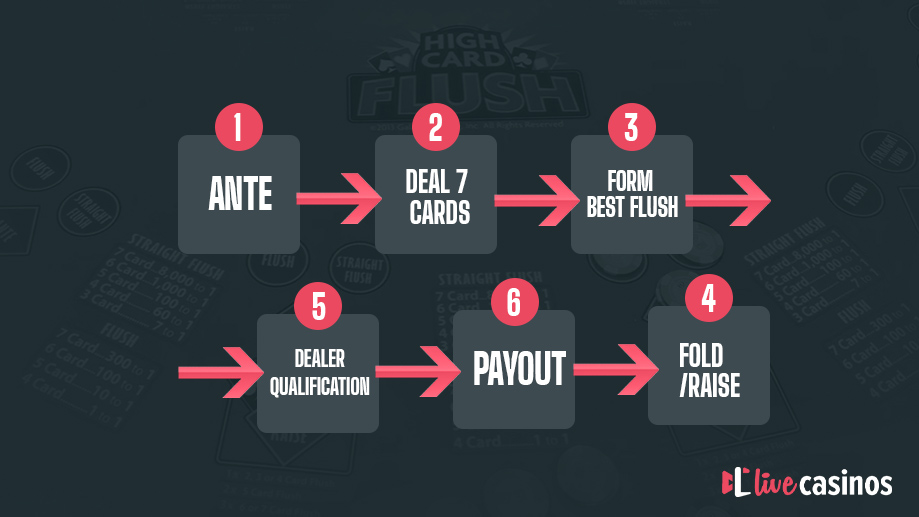
The game is played with a standard 52-card deck. Each round begins with an Ante wager, after which both player and dealer receive seven cards face down. Players then decide whether to fold (losing their Ante) or raise by placing an additional bet. What makes High Card Flush particularly engaging is that your raise amount can be larger with stronger hands—up to triple your Ante if you have a six or seven-card flush.
How to Play High Card Flush: Step-by-Step
Step 1: Placing Your Bets
Before cards are dealt, each player must place an Ante wager. Most tables have minimum bets ranging from $5 to $15, with maximums typically between $500 and $1,000.
On some tables, you can also place optional side bets:
- Flush Bonus: Pays based on the strength of your final seven-card flush, regardless of whether you beat the dealer or even fold your hand.
- Straight Flush Bonus: Pays if your cards form a straight flush of three or more cards in sequence and suit.
Step 2: The Deal
Once all bets are placed and the dealer announces “No more bets,” seven cards are dealt face down to each player and the dealer.
In High Card Flush, the dealer’s entire hand remains hidden until all players have made their decisions.
Step 3: Examine Your Hand
After receiving your seven cards, examine them to find your longest flush—the most cards you have in any single suit. This is your “maximum flush” and determines both your hand strength and your available betting options.
For example, if your seven cards are: 10♠ 9♠ 6♠ 3♠ K♥ Q♥ 7♦, you have a four-card spade flush. The hearts and diamonds don’t contribute to your flush length, so your maximum flush is four cards.
Check out our guide to poker hands if you need a detailed explanation of how poker hands are formed. Note that the Flush is the only relevant hand in High Card Flush.
Step 4: Decide Whether to Fold or Raise
Based on your hand, you have two options:
- Fold: Surrender your Ante wager and forfeit the hand. You should fold with weak hands that are unlikely to beat the dealer. However, any Flush Bonus or Straight Flush Bonus bets remain in play and will be paid if you qualify, regardless of folding.
- Raise: Place an additional wager to continue playing. The amount you can raise depends on your hand strength:
You can raise any amount up to the maximum allowed. Most players raise the full amount when they decide to play, which slightly improves your expected return – more on that later.
Step 5: Dealer Qualification
After all players have made their calls, the dealer reveals their seven cards. Before the bets are resolved, however, the dealer has to ‘qualify’ by having a sufficiently strong hand. This is similar to the dealer qualification process found in 3-card Poker, Teen Patti, or Caribbean Stud Poker.
To qualify, the dealer must have at least a three-card flush with a nine or higher as one of the cards—often expressed as “nine-high three-card flush” or better.
- If the dealer doesn’t qualify: Your Ante bet is paid even money (1:1) and your Raise bet pushes (the full stake is returned to you). This is a win for the player regardless of hand strength.
- If the dealer qualifies: The dealer’s hand is compared to yours using the hand ranking rules detailed below.
The dealer fails to qualify approximately 30% of the time. This is one of the reasons for the relatively high RTP of High Card Flush.
Step 6: Hand Comparison and Payouts
When the dealer qualifies, hands are compared based on these criteria in order of priority:
- First priority: number of cards in the flush. The most important factor for a hand’s strength is the number of cards in it. A five-card flush beats any four-card flush, regardless of the cards’ ranks. Six-card beats five-card, seven-card beats everything.
- Second priority: the highest card in the flush. If both hands have the same number of cards, compare the highest-ranking card in each flush. Ace is the highest, followed by the King, Queen, Jack, and so on down to 2.
- Third priority: second-highest, third-highest, etc. card. If the highest cards have the exact same rank, compare the second-highest card in each flush. If the second-highest cards are also of the same rank, compare the third-highest. Continue down the line until a winner is determined.
- Fourth priority: push. If all cards in both flushes are identical in rank and number, the hand is a push and all bets are returned.
If the dealer qualifies and you have the better hand, both your Ante and Raise bets are paid even money (1:1).
High Card Flush Hand Rankings
Understanding hand rankings in High Card Flush is crucial for making correct strategy decisions.
Unlike traditional poker, only the length of your flush matters initially, with card ranks serving as tiebreakers.
As you can see, around 83% of all hands will result in a three or four-card flush. Five-card flushes and longer are quite rare, which is why the game allows higher raises with these hands—you’re much more likely to win.
Example Hand Comparisons
Let’s look at some examples to clarify the ranking system:
Example 1
- Player has Q♠-10♠-8♠-6♠ (four spades)
- Dealer has A♥-K♥-5♥ (three hearts)
Result: Player wins. Four-card flush always beats three-card flush, regardless of card ranks.
Example 2
- Player has A♦-10♦-9♦-7♦,
- Dealer has K♣-Q♣-J♣-9♣
Result: Player wins. Both have four-card flushes, but the player’s highest card is an Ace while the dealer’s highest card is a King. Based on second-priority rankings, the player’s hand is stronger.
Example 3
- Player has K♠-J♠-8♠-3♠,
- Dealer has K♥-J♥-7♥-2♥
Result: Player wins. Both are King-Jack high four-card flushes, but 8 beats 7 as the third card.
Example 4:
- Player has A♣-K♣-Q♣-J♣-9♣ (ace-high straight flush)
- Dealer has A♠-K♠-J♠-10♠-2♠
Result: Player wins. Both have five-card flushes with Ace-King high. The Queen (player’s third card) beats the Jack (dealer’s third card).
The fact that the player’s cards form a straight flush is irrelevant for the main game.
Side Bets: Flush Bonus & Straight Flush Bonus
Some High Card Flush tables offer optional side bets. Broadly speaking, these optional wagers pay based on your final seven-card hand.
The outcome of the main game is irrelevant for the results of side bets – these wagers remain in play even if you fold your main hand. They’re also completely optional and can only be placed in addition to the main bet. In other words, you can’t exclusively make side bets – you need a standing Ante to bet on anything else.
Flush Bonus
The Flush Bonus bet pays when you have a four-card flush or better in your seven cards. The paytable typically looks like this:
The Flush Bonus has a house edge of approximately 7.5-8% depending on the exact paytable. This makes it a horrible bet to make in most circumstances. Of course, that’s true for most side bets in most casino table games out there.
Hitting a Flush with 6 cards or more can result in some fairly substantial payouts. However, such an outcome is extremely unlikely, and the bet’s massive house edge means that it’s probably best avoided by most players.
Straight Flush Bonus
The Straight Flush Bonus side bet in High Card Flush poker wins if you have three or more suited cards in sequential order. In other words, it wins if you hit a Straight Flush.
The longer your Straight Flush, the better the payout. A standard paytable for the side wager looks like this:
The Straight Flush Bonus comes with a massive house edge of approximately 13-15%. This makes it a horrible bet to take by any standard, and we recommend that most players give it a wide berth.
The massive payouts for six and seven-card straight flushes may seem enticing, but these hands are extraordinarily rare. The probability of a 7-card Straight Flush is so small it might as well be a statistical anomaly.
Optimal Strategy for High Card Flush
Unlike most games one can find on a casino floor, High Card Flush actually contains an element of strategy. Players can decide whether to Raise or Fold, which directly impacts the outcome of a round. This makes Raising the primary strategic decision.
However, this also means that players are expected to know when to Fold ’em and when to Hold ’em. This comes down to probabilities – the more likely your hand is to win, the more important it is for you to Raise.
Thankfully, someone has already done the number-crunching. Our strategies are based on simulations run by the famous Wizard of Odds, which you can find here.
Basic Strategy: When to Raise or Fold
Analysis by gambling mathematicians, particularly Charles Mousseau, has determined a near-optimal strategy that’s easy to remember:
- Raise with:
- Any four-card or longer flush
- Any three-card flush ranked 10-8-6 or higher.
- Fold with:
- Three-card flushes ranked lower than 10-8-6
- All two-card or one-card hands.
This simple rule produces a house edge of only 2.35% when you always raise the maximum amount allowed. The strategy is also decidedly easy to remember and implement, even for complete beginners.
Optimizing House Edge
To clarify, the strategy we described above can be further refined. According to the Wizard of Odds, deciding whether to fold a 10-high three-card Flush warrants additional analysis.
Specifically, players should consider their remaining four cards. If these cards are high, the Player should raise because the likelihood of the dealer drawing high cards (higher than 10) and a stronger Flush are reduced. On the flip side, if your non-Flush cards are low, that means that the dealer is somewhat more likely to draw a stronger Flush.
However, this approach requires a lot more work, and it will only shave off around 0.06% house edge at best. As such, most players should simply stick with the basic strategy we described above.
Raise Sizing
When you decide to raise, always bet the maximum amount allowed for your hand. Although raising smaller amounts seems like a reasonable way to limit your exposure to risk, the expected return of your bets actually decreases as well.
The reasoning is quite simple: opportunities to raise more than 1x the Ante only pop up if you have a Flush with 5 cards or more. Such a hand means that you’re already very likely to win, so you should press your advantage and squeeze out as much as possible. By raising less than the maximum, you’re leaving money on the table when you win.
House Edge and Odds Analysis
Assuming you’re using an optimal strategy (raising on 10-8-6 three-card flush or better, always raising maximum amounts), the house edge of High Card Flush is around 2.35%.
Note that this return-to-player rate can vary quite a lot depending on how you’re playing. Raising weak hands or Folding strong ones can substantially increase the house edge.
This house edge is quite low by most standards, including most other casino games. For reference, European Roulette has a house edge of 2.7%, while most slots have around 4%.
It’s also one of the lowest house advantage rates among casino poker variants. For reference, here is a quick comparison of the house of several major types of casino poker:
Hand Frequencies
Knowing how often different hands occur can help you set your expectations. Based on varied simulations, here are the probabilities:
- You’ll get a four-card flush about 1 in every 9 hands
- Five-card flushes appear roughly once every 500 hands
- Six-card flushes are rare, occurring about once per 5,900 hands
- Seven-card flushes are extraordinarily rare at roughly 1 in 8 million hands
As you can see, longer flushes are exponentially rarer, which is why they allow for a bigger Raise and thus substantially higher payouts.


























 Roulette
 Blackjack
 Baccarat
 Poker
Poker
 Sic Bo
 Dragon Tiger
 Game Shows
  Top 5 Games
  See more
  Roulette Casinos
  Low Limit
  High Limit / VIP
  Exclusive
  How to Play
  Basic Strategy
  Top Tips
  FAQ
FAQ  Blackjack Casinos
  Baccarat Casinos
  Bonuses
  Poker Casinos
  Game Providers
  Sic Bo Casinos
  Dragon Tiger Casinos
  Credit and Debit Card
  e-Wallet
  Cryptocurrency
  Bank and Checks
  Pay by Phone and SMS
  See more
  How-To Guides
  Top Lists
  In-Depth
  Strategy
  Casino & Games
  Insight
  News
News  Promotions
 Guide to Live Casinos
  Top 10 Live Casino Tips
  Studio Locations
  FAQ & Help
  Meet The Dealers
  Our Awards
  How We Rate
  Responsible Gambling


 ENG
ENG 







 Facebook
 Pinterest
 Twitter
 LinkedIn
 Copy Link